Air Serbia launches 12 new routes in 2026; now has record 5 long-haul destinations

Air Serbia is expanding quickly. In 2026, Cirium schedule data shows that a record six million seats are available. Capacity has risen by 6% year-over-year and is 69% above what was available before the COVID-19 pandemic in 2019.
Other than the pan-European ULCCs Wizz Air and Ryanair, Air Serbia is comfortably the largest airline serving the Balkans (excluding Romania and Greece). It has 8% of the available capacity, which rises to 15% when Wizz Air and Ryanair are stripped out.
According to Planespotters.net, Air Serbia’s fleet consists of 32 aircraft. It has 10 ATR 72s, eight A319s, six A320ceos, four A330-300s and four E195s. The average age is 14.9 years, which is primarily because of the A319s (19.1 years) and A320s (16.4 years).
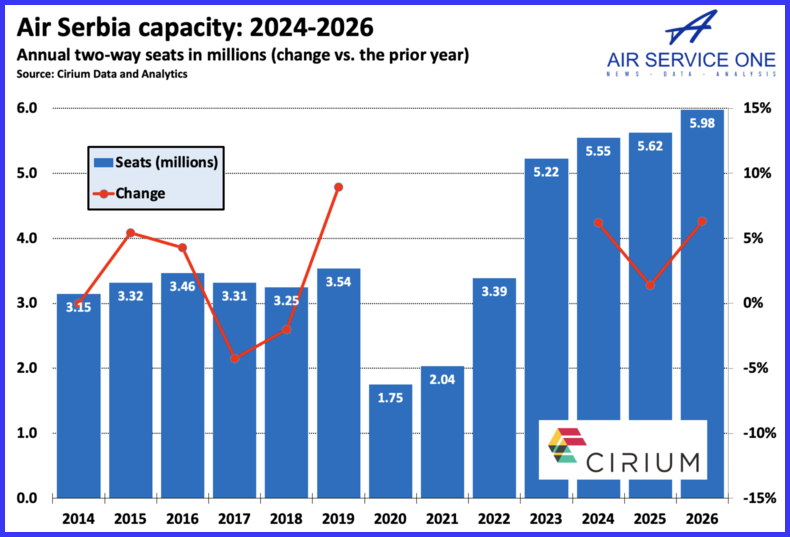
Nearly all of Air Serbia’s capacity is from Belgrade
98% of Air Serbia’s capacity is from Belgrade, the country’s capital, this year. The rest is deployed from Nis (scheduled flights to Athens, Belgrade, Cologne, Frankfurt, Istanbul IST, Ljubljana, Malta, Tivat and Vienna this year) and Kraljevo (flights to Istanbul IST, Thessaloniki and Tivat). Two routes are new from these regional locations:
- 25 October 2026: Nis-Malta (2-weekly); replacing Ryanair
- 25 October 2026: Nis-Vienna (2-weekly); replacing Ryanair
Air Serbia plans 89 scheduled routes from Belgrade. Only Lyon has been removed (last served in October 2025), while 10 routes are new this year, as shown below. The frequencies relate to what is planned for September 2026 or, if the route launches later, the number of flights in the first week of service.
- 30 April 2026: Santorini (2-weekly)
- 3 May 2026: Baku (2-weekly)
- 19 May 2026: Nizhny Novgorod (2-weekly)
- 22 May 2026: Munich (daily)
- 23 May 2026: Toronto (2-weekly)
- 1 June 2026: Alicante (2-weekly)
- 20 June 2026: Brac (2-weekly)
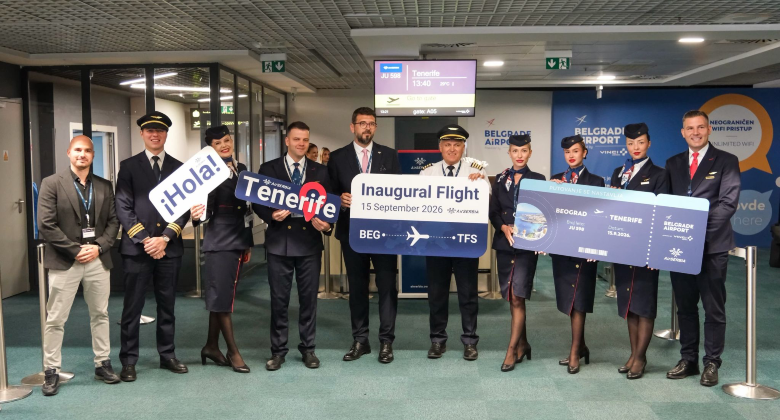
- 15 September 2026: Tenerife TFS (2-weekly)
- 30 September 2026: Seville (2-weekly)
- 14 December 2026: Tromsø (2-weekly)
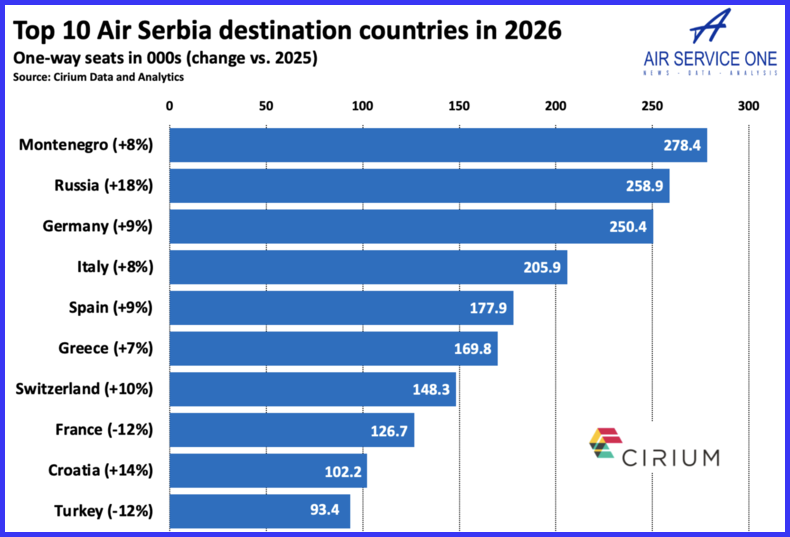
Montenegro has the most capacity, but Russia has grown massively
Air Serbia’s serves 35 countries from Belgrade, with the most capacity being deployed to Montenegro, Russia, Germany, Italy and Spain. All these countries have more seats in 2026 than in any previous year.

Compared to 2025, Azerbaijan and Canada are new nations in Air Serbia’s network. Meanwhile, double-digit growth has been experienced to Georgia (+108%), Belgium (+45%), Russia (+18%), Czech Republic (+16%), Croatia (+14%), Austria (+12%) and Switzerland (+10%).
As Serbia is not subject to Russian sanctions, the airline benefits from the considerable lack of capacity from Europe to Russia due to the ongoing war in Ukraine. This is mainly why the airline has a record 259,000 one-way seats and five routes: Kazan, Moscow SVO, Nizhny Novgorod, St. Petersburg and Sochi. In 2019, for example, only 89,000 departing seats and two routes (SVO and St. Petersburg) were available.
Most passengers fly from Russia via Belgrade to reach other European countries, with Montenegro, Spain, Italy, France and Germany being the top five most-trafficked nations. At the city level, Moscow to/from Tivat, Paris, Barcelona, Milan and Podgorica are the five most popular markets.
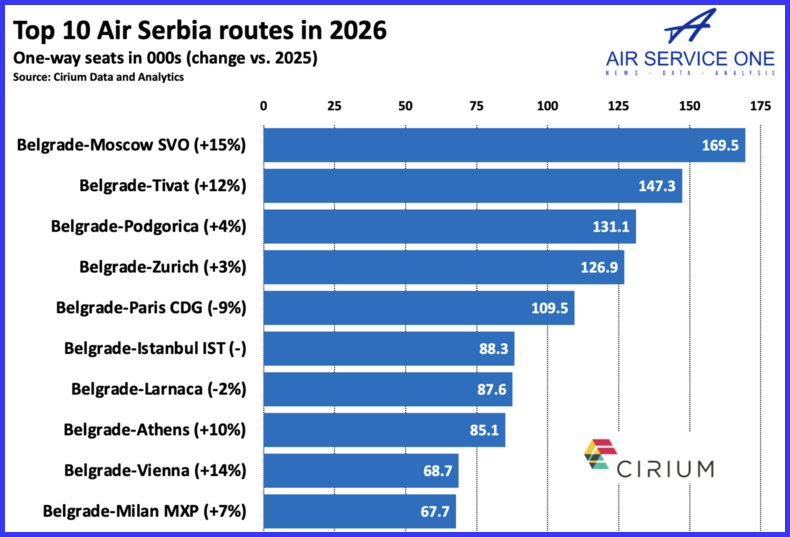
Belgrade-Moscow SVO is the top route
Air Serbia has 101 routes in 2026: 89 from Belgrade, nine from Nis and three from Kraljevo. Five are long-haul: Chicago ORD, Guangzhou, New York JFK, Shanghai PVG and – this year – Toronto. Cirium confirms that the carrier has more long-haul seats than in any prior year. Of course, this market is still a small part of Air Serbia’s total operation (5% of capacity).
With almost 170,000 one-way seats, Moscow SVO is by far the number one route. This dominance is because of using A320s and A319s and having a high overall frequency, such as 23-weekly departures in September. If flights are considered instead, SVO is third, behind Belgrade to Tivat and Podgorica, mainly because of the high use of ATR 72s and E195s.