

Air Service One talks with…… Singapore Changi Airport

With a record number of attendees at the 155th IATA Slot Conference in Singapore this November, Air Service One wanted to talk to the hosts of the event, Singapore Changi Airport, about their post-Covid recovery and expectations for 2025!
In addition, we found out which markets have been their best performing and how the state-of-the-art airport has been the first to roll out biometric immigration screening. Importantly we also got an update on the airport’s new Terminal 5 project due to start construction in the new year.
Singapore Changi Airport has now practically reached its pre-Covid passenger traffic. How many travellers do you estimate having by the end of the year and what are your expectations for 2025?
In September 2024, Changi Airport registered 5.40 million passenger movements, which represents a year-on-year growth of 10.8% (98.7% of pre-Covid levels). Year-to-date for 2024 (January – September), passenger traffic has increased 16.3% compared to 2023 and is 98.7% of pre-Covid.
Currently, Changi Airport links Singapore to 160 cities globally, with close to 100 airlines operating more than 7,000 weekly flights.
Transfer traffic is particularly important for Changi Airport. How do you attract airlines to use Singapore as a transfer hub at a time when more carriers are introducing ultra long-haul operations?
One-stop flights often complement ultra long-haul (ULR) services, as ULR flights are longer in flight duration and can be more expensive to operate. To balance various factors such as customer demand and network, airlines maintain a portfolio of routes in their network which may include niche ULR operations as well as one-stop operations. For example, while Qantas has started flying non-stop from Australia (Perth) to London, it continues to operate one of its London services via Singapore. Also, Singapore Airlines continues to operate Singapore-Narita-Los Angeles and Singapore-Frankfurt-New York flights alongside its direct ULR services to these US destinations.
Longer range aircraft also help to extend the reach of Changi’s network. It was the introduction of longer-range aircraft which allowed United Airlines and Singapore Airlines to fly non-stop to USA. The next-generation narrow-body aircraft, such as the A321XLR, will allow Singapore to be linked with new markets where the demand is still limited eg, Central Asia.
In addition, one-stop flights also cater to different passenger needs, such as budget-conscious leisure travellers or those who prefer to break up long journeys for added comfort.
From Changi Airport’s end, we strive to provide value to transferring passengers by providing a wide connectivity network to the different parts of the world, supported by a variety of airlines, to cater to the needs of passengers.
We also work to differentiate ourselves as a transit hub by creating hassle-free, seamless and memorable experiences for connecting passengers. From curating a myriad of dining and shopping options to satisfy the needs of passengers, we also ensure that there are comfortable corners and rest spaces for passengers to relax, and entertainment options for passengers from all ages, from playgrounds to gardens, on top of a swimming pool and a movie theatre.
In addition, Changi Airport also value-adds to transiting passengers with our Free Singapore Tour, which shows travellers key iconic landmarks and sights and sounds of Singapore through short guided tours. There are three itineraries to choose from, allowing them to tour the civic district, key heritage attractions or a heartland town.
Has any market particularly stood out to have performed notably better since the pandemic?
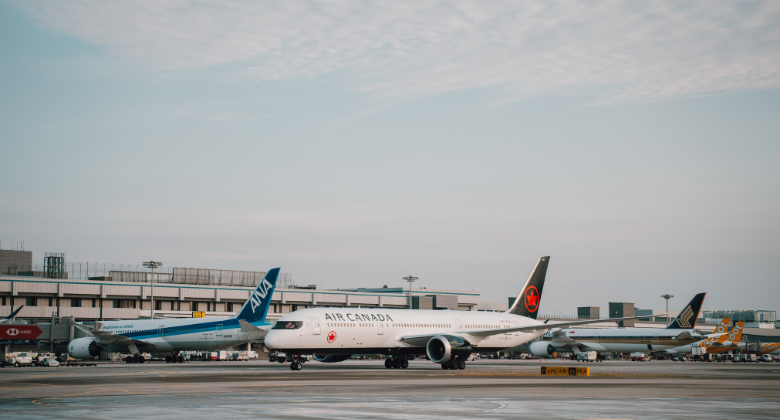
China, Japan and Hong Kong are Changi Airport’s top three markets which have shown the most growth this year.
China has risen to become Changi Airport’s top country market year-to-date, registering 5.8 million passenger movements for the period January to September. This is more than double the passenger movements recorded in the same period in 2023. Passenger traffic between China and Singapore has also exceeded pre-Covid levels for the same period.
CAG has been working closely with airline partners to seek even more destination options in China for travellers. Four new city links in China have been added to Changi’s family in the course of the year – Jieyang Chaoshan operated by Spring Airlines, Quanzhou operated by Xiamen Air, Taiyuan operated by China Eastern Airlines in September (via Sanya), and Linyi by Guangxi Beibu Airlines in September (via Nanning).
Passenger traffic between Japan and Singapore registered a year-on-year increase of 25% for the period January to September, and exceeding 2019 levels for the same period. This year, Changi welcomed two new Japanese carriers – Air Japan which operates 5x weekly flights between Tokyo (Narita) and Singapore, as well as Peach Aviation which will commence daily flights between Osaka (Kansai) and Singapore from 5 December.
While passenger traffic between Singapore and Hong Kong has not recovered to pre- Covid levels, it registered a year-on-year growth of 30% for the period January to September.

Are there any areas of the world you would like to attract more traffic from and improve connectivity?
In the near-term, we are focused on boosting our traffic and network back to pre-Covid levels and beyond, especially in the Asian region. Given that the aviation industry’s centre of gravity is shifting towards Asia Pacific due to its rising middle-class population and strong GDP growth, Changi Airport is well-positioned to capture this growth as a major international air hub located in the heart of Southeast Asia. Within the Southeast Asia region that has a population of more than 600 million, we are looking forward to growing our connectivity to secondary cities and airports.
For China, which is traditionally a top source market for Changi Airport, as we continue to expand our connectivity and work with partners to drive traffic between the two markets, we have signed a tripartite agreement with Singapore Tourism Board and Sentosa Development Corporation to do in-market joint promotions with the Chinese travel trade. In the coming months, we plan to launch a marketing campaign to introduce unique attractions and experiences of selected Chinese cities to Singapore residents.
With India also being one of Changi’s top markets, CAG also hopes to thicken connectivity on existing routes by building upon the strong demand between India and Singapore. In the medium term, we are also looking to expand our connectivity to new cities or provinces such as Jaipur (Rajasthan), Indore (Madhya Pradesh), and Surat (Gujarat).
In the Middle East, with the Kingdom of Saudi Arabia’s transformation and active promotion of tourism, CAG sees strong potential in building capacity between Saudi Arabia and Singapore, including a direct connectivity to Riyadh, expanding travellers’ travel options to the Middle East.
We are also exploring possibilities further north in Central Asia, such as Kazakhstan and Uzbekistan, which are destinations with strong destination appeal and burgeoning travel demand.
In the Europe region, we are keen to pursue opportunities to establish links to Madrid, Stockholm and Vienna. These cities are key cultural and business centres in Europe and enjoy strong demand with Singapore and the wider Southeast Asia and Southwest Pacific regions, for which Singapore is a convenient gateway. We also hope to restore a city link with Warsaw, which was operated by LOT Polish Airlines pre-pandemic.
Singapore Changi Airport will begin construction of Terminal 5 next year. Can you give us more details about the project and its expected completion date?
Changi Airport’s Terminal 5 (T5) is one of the key programmes under the Changi East development. With the ability to handle up to 50 million passenger movements per year, the terminal will enable Changi Airport to safely and effectively handle the projected large volumes of passenger traffic in the medium- to long-term and will be ready to meet the anticipated demand around the mid-2030s. It will secure Singapore’s capacity to ride onthe long-term growth of aviation, strengthening Changi Airport’s position as a premier air hub for the region and beyond.
Located within the 1,080-hectare Changi East development, T5 will be designed with the flexibility to be built in two phases, in line with traffic growth. It will also be built to facilitate the deployment of technology, such as autonomous vehicles and baggage handling robots, to automate and digitalise airport operations, to enhance the passenger experience and increase manpower productivity.
Changi Airport is the first in the world to introduce biometric immigration screening for all arriving and departing passengers. Could you tell us some of the benefits you have seen from this system and other innovations you have planned for passengers?
Since August 2024, all travellers enjoy automated clearance, and all Singapore residents enjoy immigration clearance using simply facial and iris biometrics, without the need to present their passport. Passport-less clearance has simplified the immigration clearance process, providing travellers with hassle-free and faster clearance. Passport-less clearance will be progressively implemented at all terminals in Changi Airport, reducing the time taken for travellers to clear immigration by 40%, according to the Singapore Immigration and Checkpoints Authority.
Special Assistance Lanes with automated immigration clearance for travellers in wheelchairs or in family groups with young children (up to four persons) have also been introduced at selected Departure and Arrival Immigration Halls at Changi Airport. This enhanced accessibility is also aimed at creating a more seamless travel experience for travellers who need more assistance when clearing immigration.
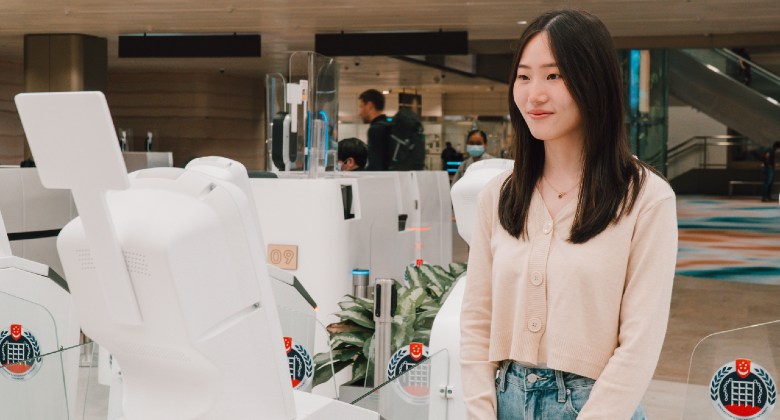
Screening
Considering Changi’s proximity to other major hubs in Asia such as Kuala Lumpur and Bangkok, what would you say is the airport’s competitive advantage over others in the region.
At Changi, we are constantly looking at providing a first-class transit experience to all passengers. From ensuring sufficient spaces for rest and relaxation through comfortable seating and themed gardens to curating shopping and dining offerings, we strive to anticipate passengers’ needs and give them a pleasant and memorable experience at Changi.
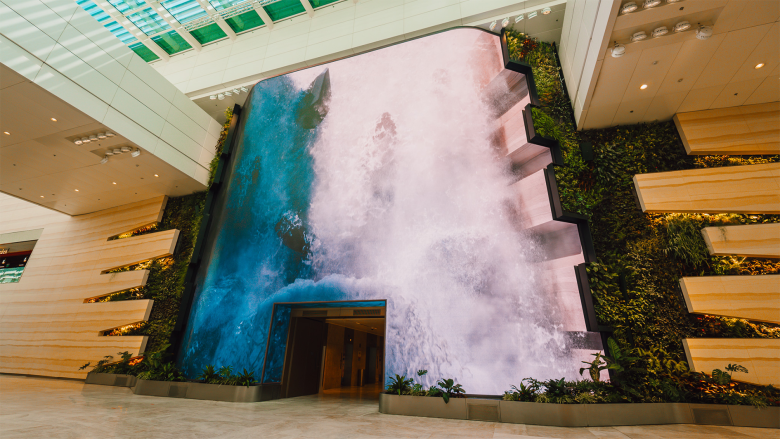
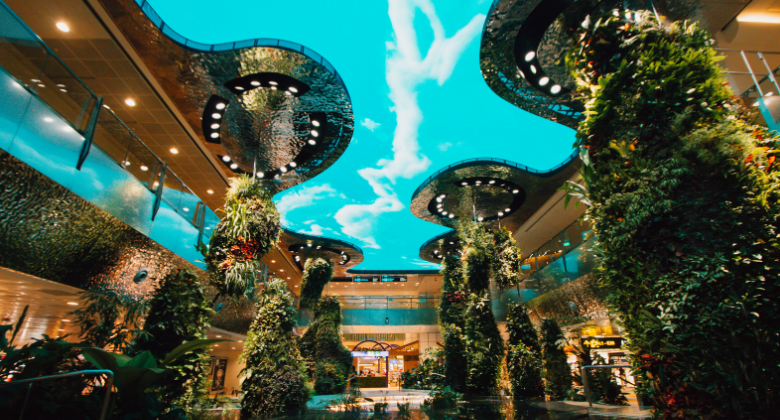
The recent upgrades done at Terminal 2 is an example of how we have brought new surprises to passengers for an enhanced travel experience. Apart from expansions made to travel facilities such as the departure, immigration and baggage claim halls, new attractions were introduced. They include The Wonderfall, a mesmerising giant digital waterfall located in the middle of the Departure Hall, and Dreamscape, an immersive indoor garden featuring an ever-changing digital sky mimicking real-time weather conditions in the transit area. Dining options were also refreshed, with a new Gourmet Garden featuring multiple local and international eateries to pique passengers’ taste buds.
More importantly, apart from the passenger experience at an airport, connectivity is ultimately the key consideration for travellers, as well as businesses. This point has gained importance in recent times, as a myriad of reasons such as geopolitical developments or new pandemics could disrupt air and sea routes any time. Changi Airport is currently connected to 160 cities in about 50 countries, served by almost 100 airlines from across the world.
As a destination, Singapore continually looks at introducing new tourism products to travellers, to offer them new and exciting experiences. One example is the upcoming Disney Adventure which will be set sail from Singapore in December 2025, the first Disney Cruise Line ship to homeport in Asia. Singapore also attracts the highest proportion of business travellers in Southeast Asia, due to MICE events and the many MNCs that have headquartered in Singapore. These differentiate Singapore from other airports in the region.
