Edmonton International Airport
Serving Alberta’s capital and a broad catchment extending across western Canada and the North, Edmonton Airport gives airlines access to a mix of business, leisure, visiting-friends-and-relatives and resource-sector demand.
Located some 26 kilometres south of the city’s downtown, Edmonton Airport is Canada’s fifth-busiest. Its 24-hour, curfew-free operation, US preclearance and two unrestricted runways provide the operational freedom to schedule, turn and scale services efficiently
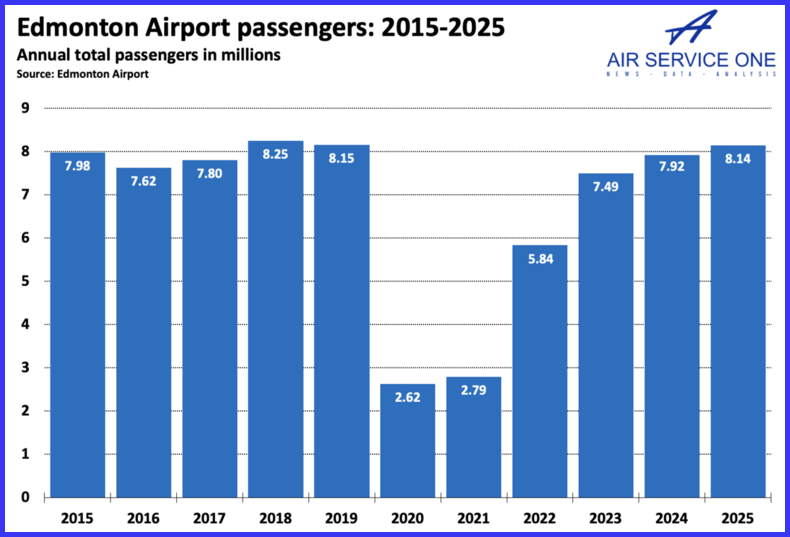
Edmonton Airport welcomed 8.14 million passengers in 2025, up 2.8% and virtually matching its 2019 high, while domestic traffic grew 6.2% to 6.11 million. Airline expansion was broad-based: capacity increased 10.5% at WestJet, 5.4% at Air Canada, 21.0% at Flair, 42.2% at United, 17.9% at KLM and 7.2% at Porter – strong evidence that the market can absorb new seats across multiple segments.
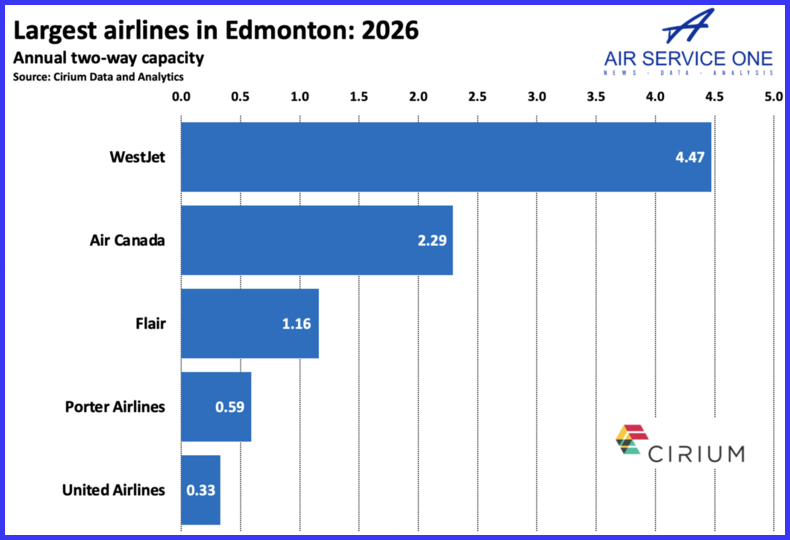
WestJet leads the airport, followed by Air Canada, Flair and fast-growing Porter; United is the largest foreign short-haul operator, while KLM’s Amsterdam service remains Edmonton’s main long-haul link.
London stands out as Edmonton’s flagship long-haul opportunity. The airport’s 2025 ‘YEG Wants London’ campaign generated demand evidence for airline discussions, supporting both strong local traffic and onward connections across the UK, Europe and Asia.
Frankfurt offers a proven re-entry opportunity following Condor’s seasonal 2023 service, while a first non-stop Asian gateway is an attractive prospect with passenger and belly-cargo potential strengthened by Edmonton Airport’s northern catchment and new cargo hub.
WestJet’s Reykjavik launch and Porter’s four new winter 2026/27 routes demonstrate how quickly domestic, US, sun and selective international markets can be developed.
YEG Ascent, a five-part capital programme, gives airline partners confidence that capacity and facilities will grow with demand. Its centrepiece is the $300 million International Cargo Hub, supported by $100 million in federal funding and planned across about 2,000 acres, creating new opportunities for dedicated freighter and belly-cargo operators.
Terminal modernisation will improve flexibility, a cargo hydrant-fuelling network will support faster and safer turns, and the 63,000-square-foot North Tower redevelopment will release terminal space for passenger growth.
Tourism Board Info

Edmonton is an increasingly compelling destination for airline route developers and network planners seeking opportunities in a large, economically resilient and underserved North American market. As Alberta’s capital and the gateway to Canada’s north, Edmonton combines strong local demand, diverse economic activity and significant potential for enhanced domestic and international connectivity.
The Edmonton metropolitan region is home to a substantial and growing population supported by an economic base extending well beyond energy. Government, education, healthcare, advanced manufacturing, technology, logistics and natural resources all generate year-round business travel. The city also serves northern and remote communities, creating important passenger flows for business, essential services and onward connections.
Edmonton International Airport provides a strategic platform for airlines targeting Western Canada. Its location offers access to Alberta’s capital region, northern Alberta and key resource industries, while its operating environment and capacity for growth create opportunities for new services and long-term network development.
Edmonton presents opportunities across multiple market segments. Domestic connectivity remains important, particularly to major Canadian business centres and underserved regional markets. Transborder services can benefit from strong links between Alberta and major U.S. economic hubs. International opportunities may also be supported by growing immigrant communities, visiting-friends-and-relatives traffic, tourism and business demand.
The region offers an attractive tourism proposition as well. Edmonton provides access to national parks, outdoor experiences, festivals, sporting events and northern destinations, helping stimulate inbound leisure traffic alongside established outbound demand.
Successful route development increasingly depends on identifying markets with diversified demand rather than relying on a single industry or passenger segment. Edmonton fits that profile. Its combination of population scale, economic importance, geographic reach and room for connectivity growth makes it a market worthy of close attention.
For route developers and network planners looking beyond the most congested gateways, Edmonton offers something particularly valuable: an opportunity to build meaningful connectivity in a market with strong fundamentals, diverse demand and considerable potential for sustainable growth in the years ahead.