


Amsterdam Schiphol looks beyond capacity constraints with ambitious expansion
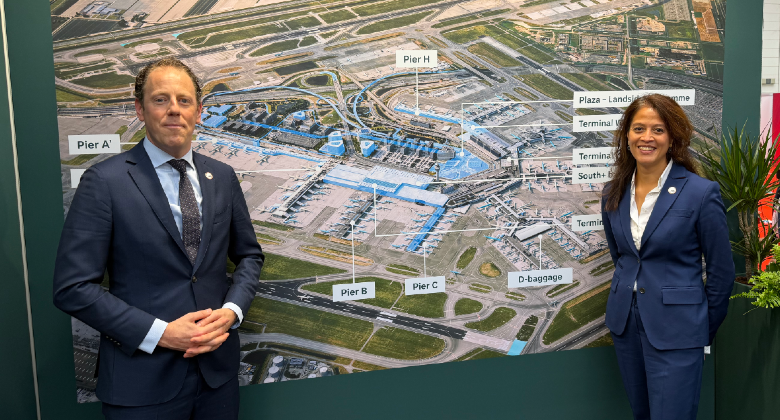
Amsterdam Airport Schiphol is preparing for a major transformation of its infrastructure while seeking to strengthen its position among Europe’s best-connected airports.
Patricia Vitalis, Chief Operating Officer at Amsterdam Airport Schiphol, and Joery Strijtveen, Head of Aviation Partnerships, spoke to Air Service One about the airport’s network strategy, infrastructure investments and long-term ambitions.
Q:Schiphol has seen strong airline and route development recently. What makes Amsterdam attractive to airlines despite its capacity constraints?
Patricia Vitalis: Schiphol has been capacity-constrained for quite some time, but our mission is to add quality, and that also applies to our destination network. I think we’ve demonstrated that even when you’re capacity-constrained, a targeted approach towards destinations and airlines can keep you among the three most connected airports. That’s what we’ve been doing for years.
Q:You’ve recently welcomed Thai Airways, Syrian Air, Middle East Airlines, IndiGo, Oman Air, Vietnam Airlines and LATAM. Where do you still see gaps in the long-haul network?
Patricia Vitalis: We just recently spoke to representatives from Phoenix. We’d really like to establish a direct connection, particularly given the number of business travellers between the two markets. We’d also really like to have a connection to Australia.
Joery Strijtveen: We’ve recently recalibrated our network strategy. We’re capacity-constrained, so we believe the available capacity should ideally be allocated to connections generating the greatest economic, political and societal value. We’ve shifted our approach from simply counting destinations to examining which connections genuinely contribute economic value. But we know you always need a mix of destinations, including leisure/VFR oriented destinations, to maintain a strong network.
Q: Are you still looking at unserved destinations in Europe, or is the priority to increase capacity and frequencies on existing routes?
Joery Strijtveen: A strong international hub needs both. European connections are important for travellers journeying directly within Europe. They also bring passengers to Schiphol who transfer here onto an intercontinental flight. We look at underserved and unserved markets where we see potential, alongside the economic and strategic importance of individual cities. We already cover most of the world’s top 50 cities in terms of connectivity and importance.
Our strategy isn’t simply about increasing the number of destinations. We look at both the breadth and depth of our network and whether a new service genuinely adds value. There are still a few European destinations where we see potential, and additional frequencies can also strengthen feed into KLM’s hub network.
Q: Schiphol handled close to 69 million passengers last year. How much further can the airport grow given the restrictions on aircraft movements?
Patricia Vitalis: Looking at our projections over the next ten to twenty years, we expect that, through measures including aircraft upgauging, we can grow towards 90 to 95 million passengers. That’s why we’ve developed a master plan covering additional terminal and pier capacity, as well as the renewal of existing infrastructure.
Joery Strijtveen: It’s important to add that the projection of 90 million passengers does not assume any increase in aircraft movements. Even taking those restrictions into account, we see significant potential for passenger growth.
Q: The new A Pier is one of the airport’s major upcoming developments. What can you tell us about the wider infrastructure programme?
Patricia Vitalis: We’re preparing to open the A Pier in April 2027. Initially, we’ll use it for narrow-body European operations, which will allow us to renew the C Pier, one of our oldest and most important facilities.
The A Pier is an impressive development, with extensive glazing, greenery and a strong focus on passenger convenience. It really represents what we want the Schiphol of the future to look like.
We’re also planning to redevelop the H Pier as part of our Masterplan, replacing seven narrow-body positions with four wide-body positions. Another major project will be the new South Terminal, covering approximately 100,000 square metres where we will focus on developing the baggage hall first. We’re currently in the design phase, with the baggage-handling basement expected in the early 2030s and the terminal itself around the middle of that decade.

One important principle is that we’ll retain Schiphol’s integrated one-terminal concept. The new facilities will remain connected rather than operating as separate terminals.
It’s a phenomenal project, and we’re talking about investments of approximately €1 billion annually over the next twenty years.
Q: Looking ahead to 2027, what are the main priorities for passenger growth and route development?
Patricia Vitalis: Next year is particularly important because we’ll be opening the A Pier and bringing it into operation. I think that’s something everyone will notice. Opening a new pier is a significant development at an established international hub.
Joery Strijtveen: From a route-development perspective, we’ll continue pursuing our priority opportunities. We’re operating in a heavily constrained environment, but we’re seeing considerable slot mobility at Schiphol.
With the pressures airlines are facing, particularly fuel costs, there’s greater scrutiny of route performance, especially on short- and medium-haul services. Some airlines are rationalising their European networks, and upgauging means seat capacity can remain stable or increase even as frequencies decline. That can free up slots for new services. The arrivals of Thai Airways, Syrian Air, Middle East Airlines, Oman Air and LATAM have been made possible partly because of these developments.
Q: How is passenger demand holding up amid the pressures facing the industry?
Joery Strijtveen: The Dutch market remains strong. We’re still recording passenger growth, load factors are very healthy, and we expect that trend to continue next year.
Asia has performed particularly strongly as passengers have sought alternative routings around the Middle East. We’ve seen Singapore Airlines adding extra flights and KLM increasing Bangkok services, with very strong demand.
The question is how long that can continue. Fuel prices have remained elevated, and airlines are facing considerable cost pressures even when load factors are strong.
Q: Finally, what is your long-term vision for Schiphol?
Patricia Vitalis: We have a very ambitious agenda. It’s not just about the master plan. We want to be a high-quality airport delivering reliable operational performance while maintaining strong relationships with airlines and other stakeholders.
We’re making significant progress, although we’re not where we want to be just yet. I’m convinced that within a few years we’ll have reached the next level of quality we’re aiming for.
Joery Strijtveen: We’re not trying to become a new mega-airport like those being developed in Asia or the Middle East. We want to be a reliable, high-quality airport offering good value for money and maintaining a strong network.
For a relatively small country, maintaining such extensive international connectivity is a major achievement. We want to be among the leading airports in terms of quality, connectivity and operational performance. Those things are closely interconnected.
