

Asia sees full but uneven recovery

Asia’s aviation sector is finally emerging from the impacts of the Covid-19 pandemic, data for the fourth and final quarter of 2024 shows. Being the first region to experience the brunt of travel restrictions and boarder closures in early 2020, many Asian countries were also some of the last to fully reopen, prolonging the recovery process.
Key markets such as China and India have witnessed a resurgence in air travel, driven by increased capacity, pent-up demand, and improved connectivity across the region. The demand for both domestic and international flights has surged, supported by rising consumer confidence in air travel.
Analysis of capacity data provided by airlines to Cirium shows that Asia has 543,982,593 available seats in Q4, representing an increase of 10.9% on the same period last year, and an improvement of 6.4% compared to the pre-pandemic 2019, illustrating a full recovery.
Among the largest markets on the continent (highlighted in red), India and China have surpassed their pre-pandemic capacity levels, marking a significant milestone in the region’s recovery. India, in particular, has experienced a boom in domestic and short-haul international routes, driven by economic growth and a rapidly expanding middle class.
China has also benefited from its strong domestic travel demand and the gradual reopening of international routes. Meanwhile, Japan has nearly reached its 2019 capacity levels, reflecting the country’s efforts to revive its tourism sector, especially through promotional campaigns and relaxed visa requirements for key inbound markets.

Central Asia emerges as major growth driver
The continent’s aviation recovery is being fuelled not just by the traditional powerhouses, but also by Central Asian nations, such as Uzbekistan, Kyrgyzstan, Tajikistan and Kazakhstan. These countries, which were part of the former Soviet Union, have seen a marked increase in air traffic. The surge is in part due to geopolitical shifts, specifically the sanctions imposed on Russia following the conflict in Ukraine. As a result, many Russian nationals have opted to emigrate to these Central Asian countries or use them as transit hubs to reach their final destinations, as none of them have opted to join the mainly western-imposed sanctions.
Uzbekistan and Kazakhstan have emerged as popular transfer points, with several airlines from these countries expanding their international routes to meet the growing demand.

Additionally, the influx of Russian businesses and expatriates into Central Asia has boosted both passenger and cargo traffic, making these nations critical nodes in the regional aviation network. The result is a new dynamic in Asian air travel, where the growth is not just concentrated in the larger markets but also in emerging ones driven by geopolitical factors.
Geopolitical issues impact some Asian markets
The recovery has not been uniform across the continent. Several markets are still grappling with the fallout of geopolitical challenges that have hindered their aviation sectors from reaching pre-pandemic levels.
In Myanmar, the aviation sector has been severely affected by the imposition of international sanctions and the ongoing military insurgency. Many foreign airlines have ceased operations in the country, leading to a significant reduction in capacity. The political instability has also dampened tourism and business travel, further slowing the recovery of its aviation industry.
Afghanistan, too, has seen a steep decline in air traffic following the Taliban’s takeover in 2021. The country’s airspace has become increasingly restricted, and many international airlines have suspended their services due to security concerns. This isolation has had a significant impact on the country’s connectivity, leaving it largely dependent on humanitarian and cargo flights.
Meanwhile, North Korea remains the last Asian nation to reopen from the pandemic. The country’s aviation sector is in limbo, with no clear timeline for the resumption of scheduled international flights. Air Koryo, the national carrier, has yet to reinstate its services to China, which was the only foreign country maintaining nonstop flights to Pyongyang before the pandemic. Similarly, Air China has not restored its Beijing – Pyongyang service. The lack of connectivity has further isolated North Korea, creating a stark contrast to the broader recovery seen elsewhere in Asia.
Chinese carriers dominate Asian market
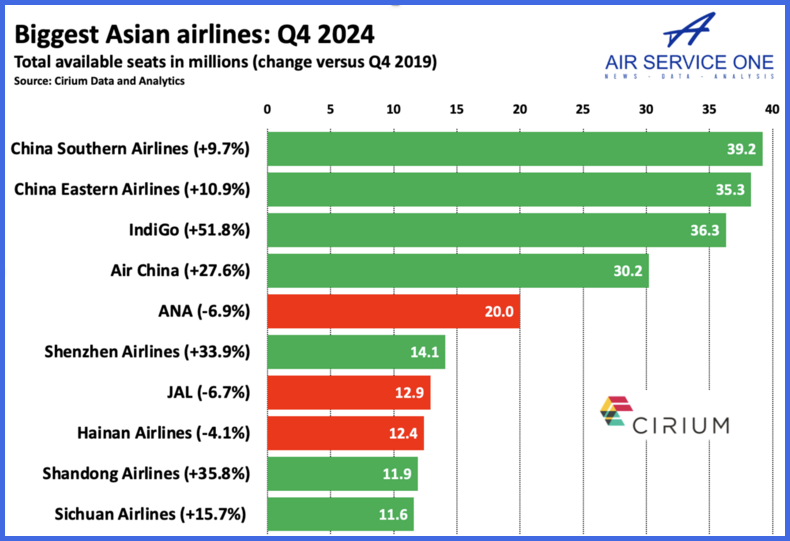
China Southern Airlines and China Eastern Airlines, ranked as the world’s sixth and seventh largest carriers by available seat capacity in 2024, are Asia’s two leading airlines. While robust domestic demand has been a key driver of their growth, both airlines have significantly expanded their international networks, particularly targeting routes to Europe.
This expansion comes in response to a reduction in services by European airlines to China, driven by increased costs due to their inability to use Russian airspace. In contrast, Chinese carriers continue to overfly Russia, allowing them to maintain shorter flight times, lower operational costs, and more competitive airfares.
