Australia’s international capacity at record level, with multiple new foreign airlines
Australia is the world’s 26th-largest country based on international capacity. This does not, of course, reflect total or point-to-point traffic. If that data were available, Australia would rank slightly higher up the table.
According to Cirium schedule data, Australia has 15.1 million one-way international seats in the first half of 2026 (January-June). This is by far the country’s most capacity to date. It is up by a tenth year-over-year, and 13% higher than before the pandemic in 2019. It has well and truly recovered.
Three-quarters of the seats are provided by foreign airlines
Cirium data indicates that Australia is served by nearly 60 foreign passenger operators. Their capacity has risen by a measly 1% year-over-year, against 14% for Australian carriers.
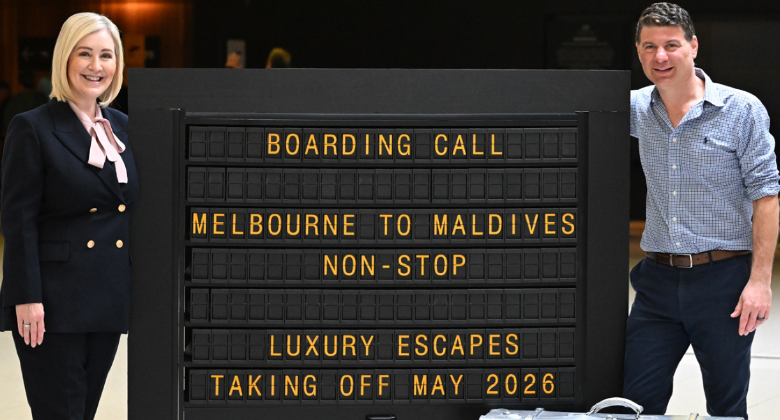
New international entrants in the first half of 2026 include Maldivian. Its Australian debut will occur on 18 May, with charter flights from Male to Melbourne (weekly). It’ll be the first time that the long market has had non-stop flights. The development means Melbourne will have flights to three cities in South Asia this year.
Looking further ahead, additional carriers include Finnair, which will debut from Helsinki to Melbourne via Bangkok BKK (daily). It will leave the Nordics on 25 October. It will be the third European airline in Australia, joining British Airways (Sydney) and Turkish Airlines (Melbourne and Sydney).

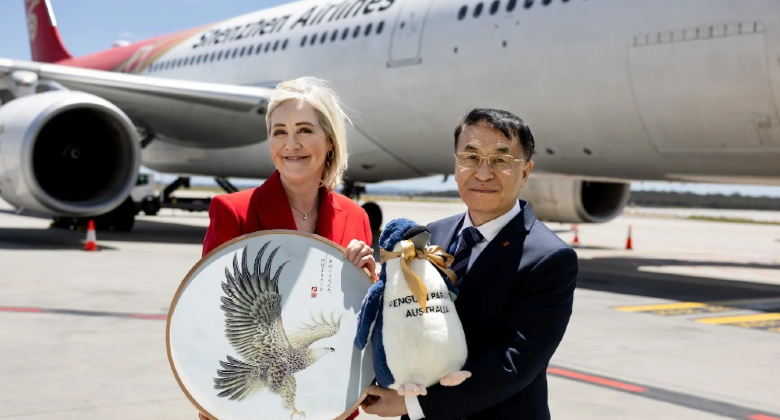
Just before Christmas, on 22 December 2025, Shenzhen Airlines began its first route to Australia, with the launch of Shenzhen-Melbourne flights (3-weekly). That city pair was last served by China Southern in 2020. In the first half of 2026, Melbourne will now have non-stop and one-stop flights to 11 Chinese airports.

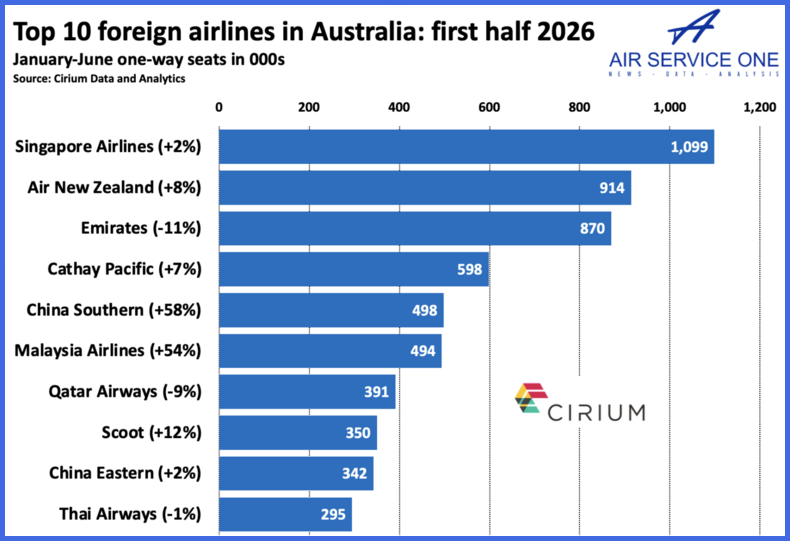
Singapore Airlines is the leading foreign operator
With almost 1.1 million one-way seats, Singapore Airlines remains Australia’s top foreign carrier. It has seven routes from its Changi hub to Adelaide, Brisbane, Cairns, Darwin, Melbourne, Perth and Sydney. Some 140-weekly one-way flights are available in February.
Air New Zealand is now Australia’s second-largest foreign operator. This is due to its capacity rising by a strong 8% year-over-year. Meanwhile, the capacity provided by Emirates, which ranked second last year, has fallen by 11%. Part of the reason is lower-capacity aircraft, reducing seats/flight from 449 to 437.
ANZ plans 20 routes, up two compared to the first half of 2025. On 28 October 2025, it launched Adelaide-Christchurch (2-weekly). It was the first time that city pair had been served. On 22 June 2026, it will resume Queenstown-Brisbane (3-weekly), having last served it in 2021. It will join Jetstar, Qantas and Virgin Australia, with four airlines operating for the first time in 13 years.