Brussels BRU has gained multiple airlines; Brussels Airlines has 40% of Q3 seats; Barcelona top market

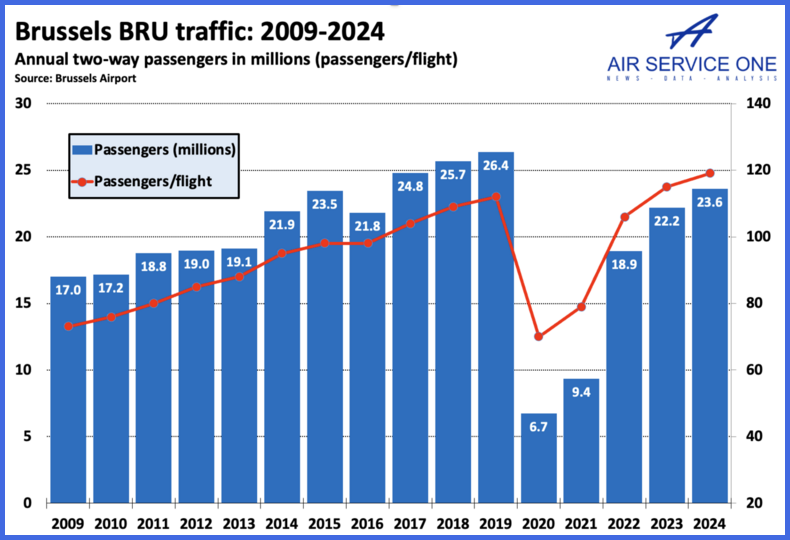
Brussels BRU welcomed 23.6 million passengers in 2024, which was the airport’s fourth-highest traffic volume in history. The airport’s statistics show this was its highest result since 2020, but throughput remained down by a tenth compared to before the pandemic in 2019.
Particularly reflecting the fact that Brussels Airlines (formerly Sabena) no longer uses RJs or turboprops, BRU’s number of passengers per flight has increased from 73 in 2009 to a record 119 last year. Planespotters.net shows that the home carrier now exclusively uses Airbus aircraft: 16 A320ceos, 14 A319s, 11 A330-300s and five A320neos.
BRU has welcomed various airlines since last December
The recent launch or relaunch of various carriers has assisted BRU’s development. On 1 December 2024, Thai Airways returned from Bangkok BKK (daily), having last served the Belgian capital between November 2011 and March 2020.
It was followed by the start of HiSky Europe flights from Bucharest on 3 March 2025 (3-weekly), FlyOne Armenia from Yerevan on 30 March (2-weekly) and Chalair from Brive on 3 July (2-weekly).
On August 4, Cathay Pacific restarted flights from Hong Kong (4-weekly), having last flown the route between March 2018 and 2020. It is not all good news. Wizz Air pulled out of BRU in January 2025. It flew from Budapest.

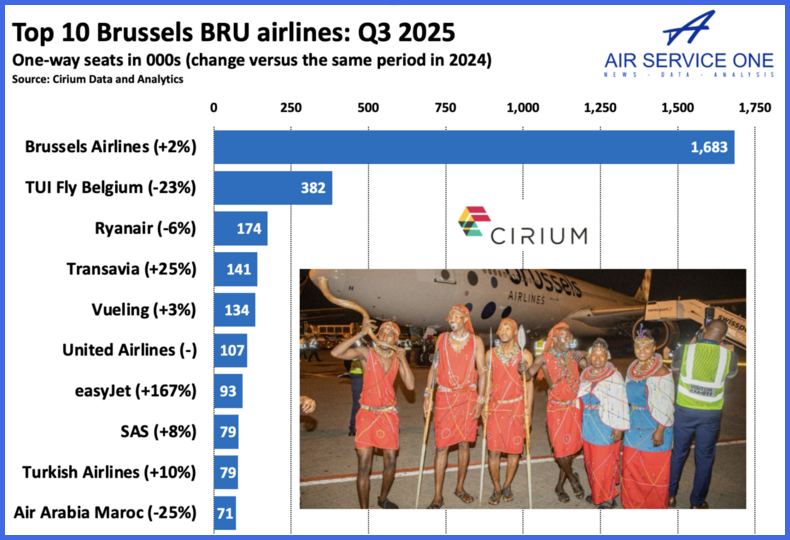
Brussels Airlines has 40% of seats
Brussels Airlines’ Q3 network comprises 90 destinations in Africa (23 airports), Asia (one; Yerevan), Europe (63), the Middle East (one; Tel Aviv) and North America (two; New York JFK and Washington IAD). Frankfurt is the most-served market, which is influenced by Brussels Airlines being a Lufthansa Group carrier and Star Alliance member, and growing as Lufthansa has cut back.

Compared to Q3 2024, three destinations have rejoined Brussels Airlines’ network: Birmingham (returned in October 2024; ends in October 2025), Funchal (resumed in April 2025) and Fuerteventura (restarted in October 2024). However, it has ended flights to Luanda (March 2025).
easyJet has served BRU since October 2007. It has 93,000 one-way seats in Q3, up by 167% year-on-year. The expansion was driven by routes being added to Bordeaux, Milan LIN and Rome FCO. However, its third-quarter capacity is down from a record 139,000 one-way seats, which was in 2014. This was when it had 10 routes (including the short link to London LGW) against five now.
Barcelona replaces Madrid as BRU’s top market
BRU’s passenger airlines have non-stop and one-stop flights to 170+ airports in Q3. Compared to a year ago, Cirium shows that Atlanta, Bangkok, Birmingham, Bordeaux, Brive, Curacao and Hong Kong are now served. However, Dalaman, Larnaca, Luanda, Montego Bay, Murcia and Ponta Delgada are among places that have been removed.
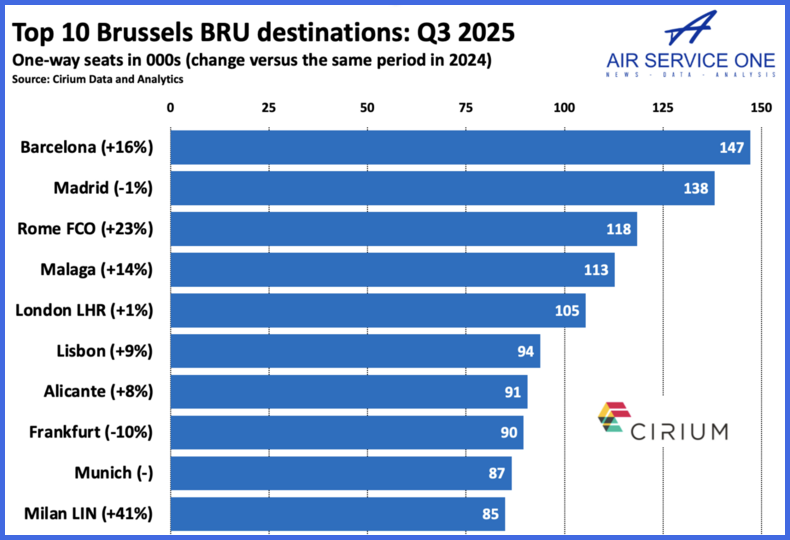
Compared to a year ago, LIN has joined the top 10 list due to easyJet’s entry, which competes with Brussels Airlines and ITA Airways. It is the first time in a decade that the market has had three or more operators. LIN pushed Copenhagen out of the top 10.
With 147,000 one-way seats, Barcelona is now BRU’s most-served destination. Due to strong growth of 16%, it has overtaken Madrid for the top spot. Some 60-weekly one-way flights are available in August, provided by Vueling (29), Brussels Airlines (19) and Ryanair (12).