Canada to Asia-Pacific capacity remains down by 24% despite many new routes
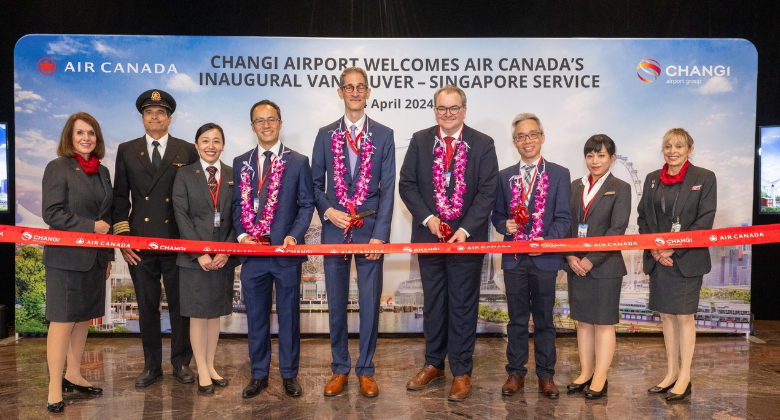
Asia-Pacific accounts for just over a fifth of Canada’s long-haul available capacity this summer, 11 percentage points lower than in S19. The market remains down by a considerable quarter versus S19, primarily because of the extremely slow recovery of China. In contrast, Canada’s long-haul capacity generally has risen by 2%.
Multiple new routes
Despite Asia-Pacific’s slow resurgence from Canada, various new routes have started recently or will do so soon, based on analysing Cirium data for 2022-2024. Several of the airport pairs have never been served before.
- 18 June 2024: Air Canada, Montreal-Seoul ICN
- 17 June 2024: Air Canada, Toronto-Osaka KIX
- 17 May 2024: WestJet, Calgary-Seoul ICN
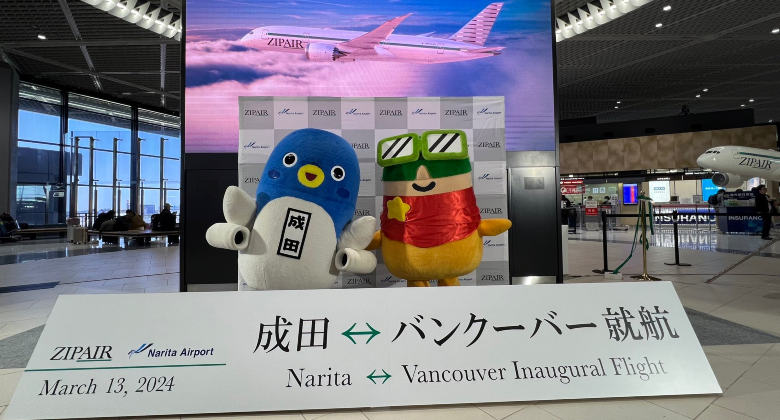
- 13 March 2024: ZIPAIR, Vancouver-Tokyo NRT
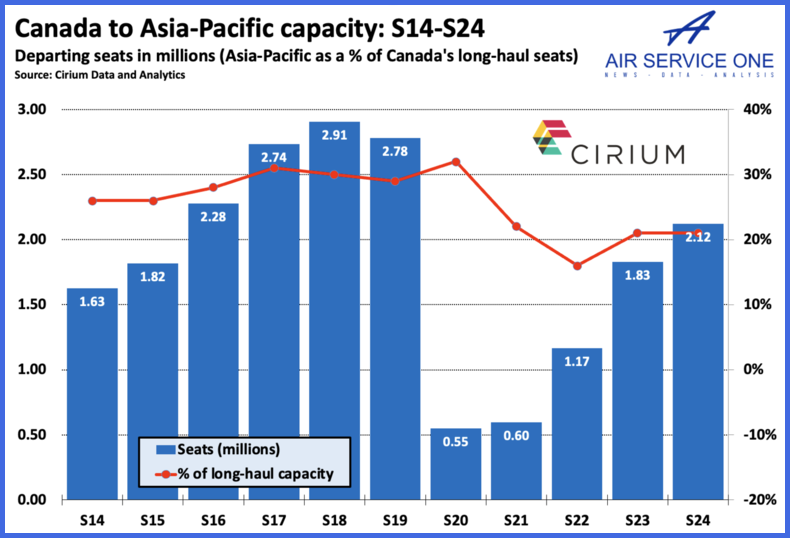
- 3 April 2024: Air Canada, Vancouver-Singapore
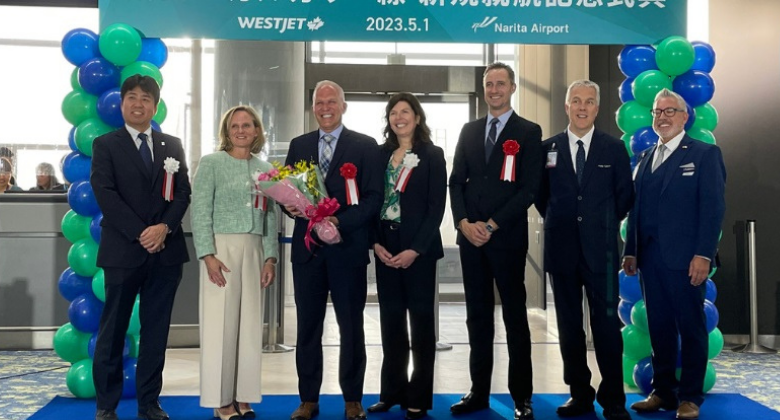
- 30 April 2023: WestJet, Calgary-Tokyo NRT
- 1 December 2022: Air Canada, Vancouver-Bangkok
- 29 October 2022: Air Canada, Toronto-London LHR-Mumbai
Vancouver previously had Singapore flights by Singapore Airlines (2021-2023 at times tagged with Seattle) and Air Canada (until 1991). Canada’s flag carrier returned after 33 years with a 4-weekly service, which has become its longest non-stop route.
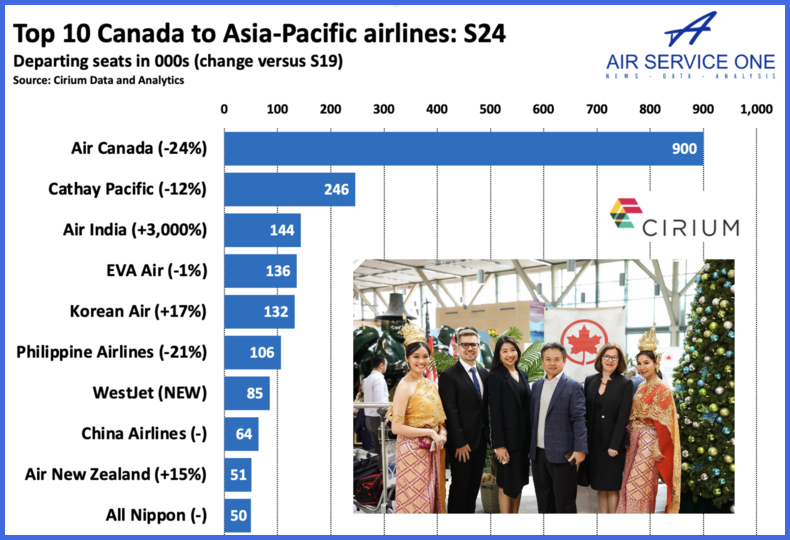
Air Canada has more than four in 10 Asia-Pacific seats
While Air Canadia inevitably remains the largest operator, its capacity is almost a quarter lower than in S19. It is the worst impacted of the top 10 operators, with only Philippine Airlines (-21%) coming close.
Air Canada has 18 routes: nine from Vancouver, six from Toronto and three from Montreal. Its network comprises 12 Asia-Pacific airports. In order of S24 seats, they are Tokyo NRT, Seoul ICN, Sydney, Hong Kong, Delhi, Tokyo HND, Brisbane, Osaka KIX, Shanghai PVG, Singapore, Bangkok and Mumbai. The latter is winter-seasonal but resumes on the last day of S24. Beijing PEK, Melbourne and Taipei, which were served in S19, no longer see Air Canada’s metal.

Vancouver has half of Asia-Pacific capacity
Vancouver is Canada’s primary gateway to Asia-Pacific. It has more than one in two available seats in S24. Cirium shows that only Calgary’s capacity has increased year-on-year due to WestJet’s development, although it remains a small non-stop market.
- Vancouver: 1.20 million departing seats in S24 (-25.4%)
- Toronto: 705,000 (-25.6%)
- Montreal: 133,000 (-19.7%)
- Calgary: 85,000 (+38.1%)
Vancouver’s passenger flights are provided by 17 operators. While Air Canada is, of course, number one, the others, based on S24 capacity, are Cathay Pacific, Philippine Airlines, Korean Air, Air India (began in 2020), EVA Air, China Airlines, Air New Zealand, All Nippon, Japan Airlines, ZIPAIR (2024), Fiji Airways (2022), Qantas, Air China, Sichuan Airlines, Hainan Airlines and Xiamen Air.
Vancouver has lost various airlines since 2019. They include Beijing Capital, Hong Kong Airlines and Singapore Airlines. Air France, Air Tahiti Nui and French bee previously stopped in Vancouver between the Pacific and Europe. Air France now only operates to/from Paris CDG.
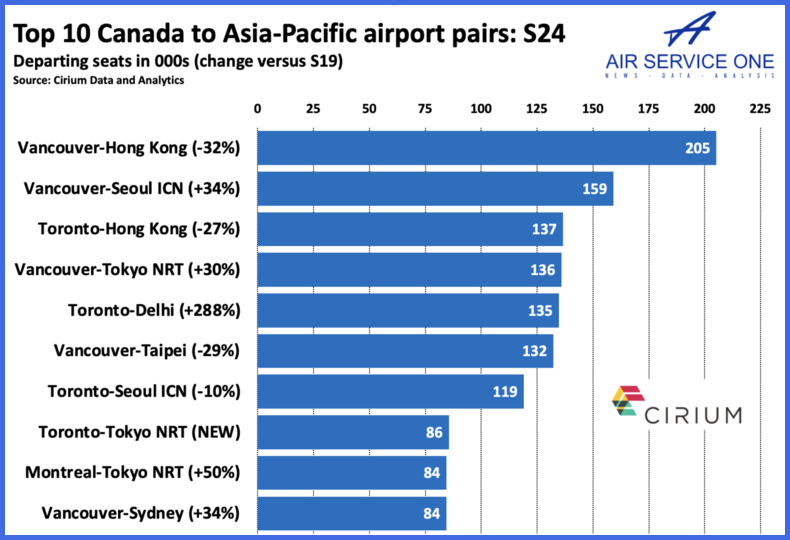
37+ airport pairs in S24; Vancouver-Hong Kong leads
Canada has flights to 26 Asia-Pacific airports in 14 countries, with Japan, Hong Kong, South Korea, India and Taiwan having the most available seats.
In S19, China was firmly number one, with twice the number of seats as the second-ranked Japan. However, China seats are 90% lower than what they were. In contrast, Japan is +46%, South Korea +28% and India +161%.
As in S19, Vancouver-Hong Kong is Canada’s leading Asia-Pacific airport pair. It is one of five of the top 10 from British Columbia. It is served 21-weekly in July with Air Canada (11-weekly) and Cathay Pacific (10). However, there were 31 weekly flights in July 2019 when Hong Kong Airlines operated. The two incumbents have both increased frequencies from daily.