

easyJet’s Q3 capacity is up by just 1% compared to 2019; the UK has grown the most
easyJet is the second-largest airline serving Europe. According to Cirium schedules information, it has 30.5 million seats in Q3 2024 (July-September). Perhaps surprisingly, it has grown by about 1% compared to the pre-pandemic Q3 2019, helping with LF and yields. Despite the small increase, it has risen by double the amount of Europe’s short-haul market. easyJet now has about 1 in 12 of that market’s available seats.
The strong get stronger: the UK is easyJet’s fastest-growing country
easyJet serves 32 countries in Q3 (it may differ at other times). The UK remains its largest market, with two-and-a-half times the capacity of number two, France. It serves one fewer nation than in Q3 2019. Gone are Estonia, Finland, Israel, and Norway, although Israel is due to return next year, depending on the war. In contrast, Albania, Macedonia and Tunisia have joined its network.
Only 13 of the 29 countries easyJet served then and now have grown. On an actual change basis, the UK – already its leading market – has expanded considerably, followed by Portugal and Greece.
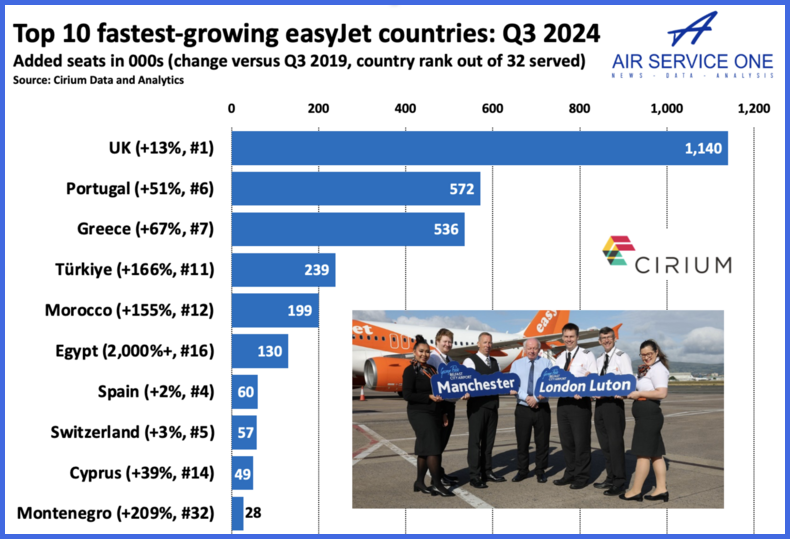
easyJet’s UK increase was primarily from the domestic market following Flybe’s end. It has risen by 35%, with 50 routes, up from 37. In contrast, international has risen by 4%.
easyJet serves 20 UK airports in Q3 2024, compared to 16 five years ago. Belfast BHD, Leeds Bradford, Newquayand Southampton are now served, with a new base at Birmingham. easyJet’s London SEN base will reopen in 2025.
While from much smaller bases, notice that Türkiye, Morocco and Egypt have grown well. Compared to 2019, Istanbul IST, Rabat, Cairo SPX, Marsa Alam, and Sharm El Sheikh have joined its network.
Germany has reduced the most, and it has nearly exited the Austrian market
easyJet’s withdrawal from the German market has been written about extensively. It has fallen by nearly 1.9 million seats compared to Q3 2019. Germany is now the airline’s ninth most-served country, down by four places. It has just 2.4% of easyJet’s capacity, reduced from 14.6% five years ago.
The reduction is due to exiting the domestic market (it had 823,000 seats in Q3 2019) and a 59% smaller international footprint. If Germany was excluded from the analysis, easyJet’s peak system capacity would be up by +7% rather than +1%.
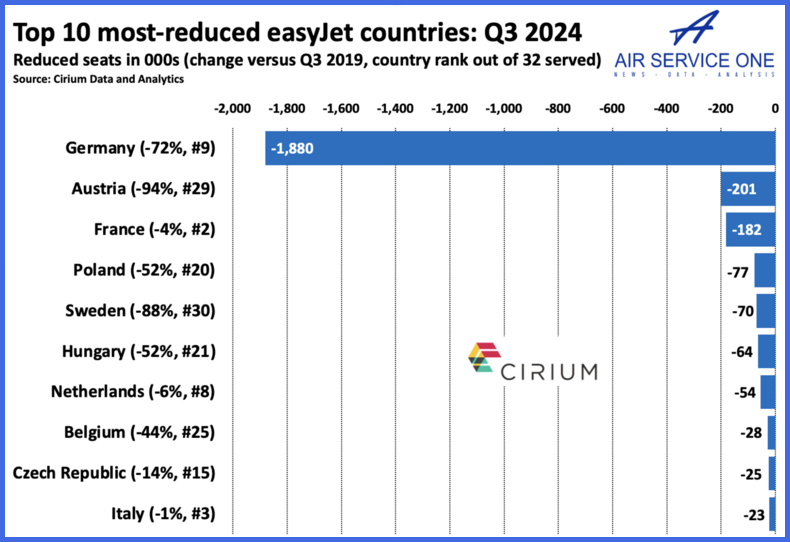
It has stopped flying to Berlin SXF (closed), Berlin TXL (closed), Cologne, Dortmund, Dresden, Düsseldorf, Frankfurt, Stuttgart and Westerland, while substantial cuts were made to the still-served Hamburg and Munich. Now, it only serves Berlin BER, Hamburg and Munich, with 61 routes. Out of 145 airports in easyJet’s network in Q3, BER ranks 15th, Munich 89th and Hamburg 95th.
