


Europe set for further growth this winter

Europe’s commercial aviation market is heading into the 2026/27 winter season with continued growth, although the pace and distribution of that expansion will be increasingly uneven.
According to Cirium schedule data, Europe has a record of just over 810 million seats on the market during Q4 2026 and Q1 2027, representing a year-on-year increase of 3.7%, or an additional 29 million seats.
LCCs continue to drive expansion
Low-cost carriers remain the main engine of capacity growth this winter. Ryanair has announced its largest winter schedule to date, while Wizz Air is continuing with its rapid expansion as aircraft affected by Pratt & Whitney engine inspections gradually re-enter service.
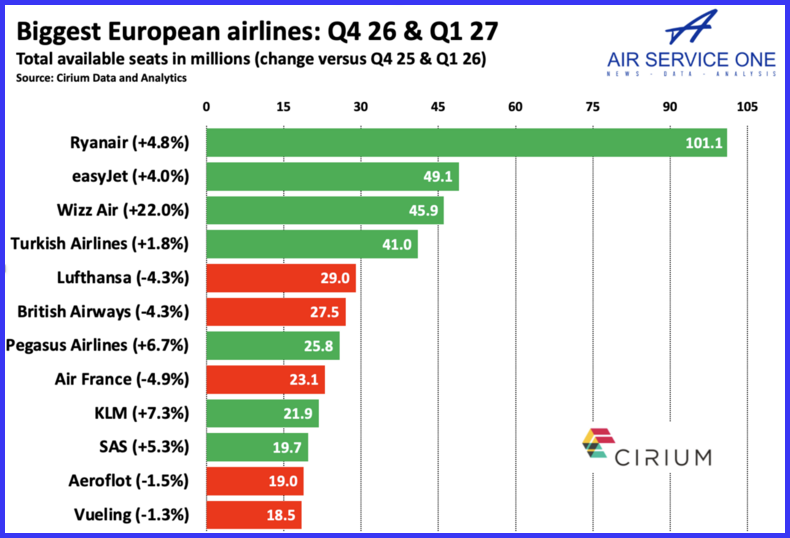
Growth shifts south and east
Capacity is increasingly being redistributed rather than added evenly across the continent. Southern and eastern European markets continue to outperform, supported by resilient leisure and visiting-friends-and-relatives traffic. Italy, Spain, Central and Eastern Europe and parts of the Balkans are expected to remain among the stronger performers, while North Africa is becoming an increasingly important extension of the European short-haul market.
Ryanair, for example, is shifting aircraft towards lower-cost markets including Albania, Italy and Morocco, while reducing exposure to more expensive airports and markets.

The United Kingdom and Spain remain the continent’s two biggest markets by scheduled capacity, followed by Germany, Italy Türkiye and France. The strongest momentum is increasingly concentrated in southern Europe.
Poland, although still considerably smaller, is the fastest-growing market among Europe’s ten largest this winter, with capacity rising by over 12%.
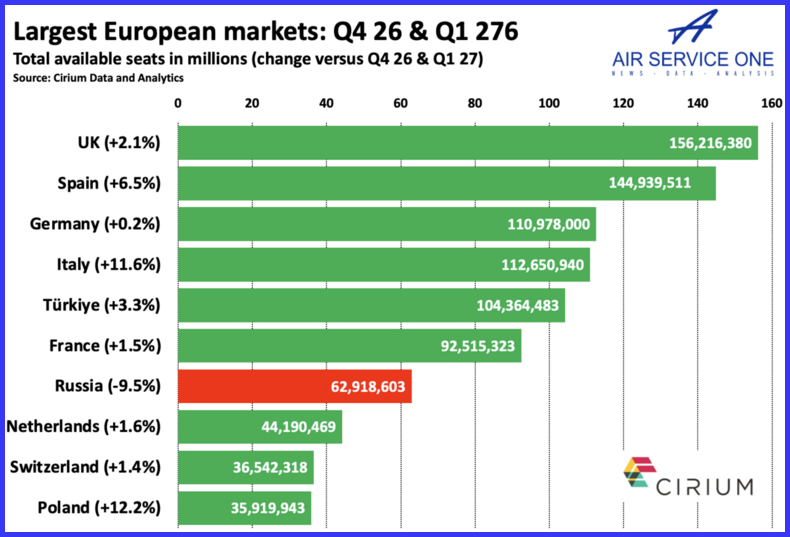
Despite its size, Germany is still lagging behind several European markets. Passenger numbers at German airports declined 1.2% during the first half of 2026, while Ryanair is closing its Berlin base at the start of the winter season and halving its operations at the airport. At the same time, Lufthansa has been exercising greater capacity discipline as it focuses on improving profitability at its core hubs.
The winter continues to reinforce several trends already evident so far this year, including stronger low-cost penetration, continued growth outside Europe’s traditionally largest markets, greater emphasis on year-round leisure destinations and increasingly aggressive competition between airports for airline capacity.
The biggest uncertainty remains geopolitics, particularly developments in the Middle East, together with fuel prices and continuing aircraft and engine supply constraints.