


Europe set for record winter but challenges loom

Building on the momentum of a robust summer season, the European aviation sector is poised for yet another record-breaking quarter between October and December.
While the overall outlook remains optimistic, airlines may encounter several challenges in the coming months. Capacity constraints, driven by ongoing supply chain disruptions, could necessitate adjustments in the number of available seats during the fourth quarter. Furthermore, persistent cost pressures, coupled with weaker airfares, could potentially impact revenue growth.
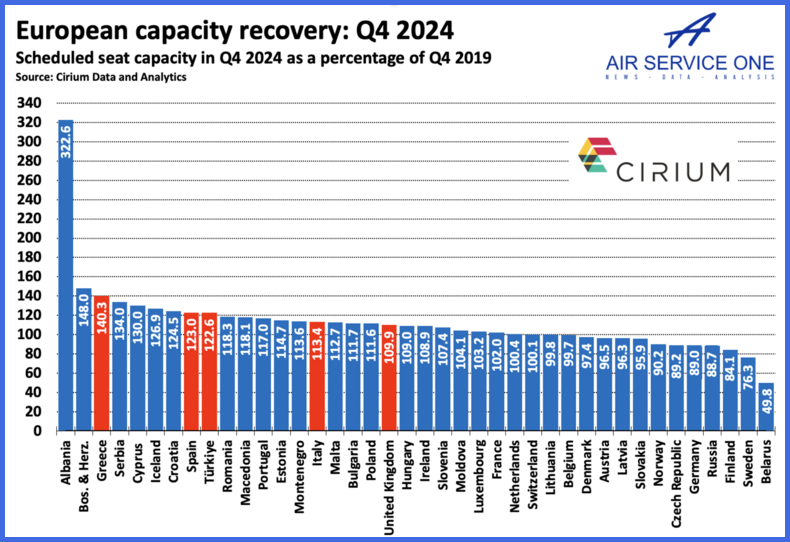
Analysis of capacity data provided by airlines to Cirium shows that Europe has 400.6 million available seats in Q4, representing an increase of 7.6% on the same period last year, and an improvement of 4.5% compared to the pre-pandemic 2019, illustrating a full recovery.
Among Europe’s largest markets (highlighted in red), four out of five are in the south of the continent on the Mediterranean coast. This is notable, as it illustrates a reduction in seasonality, which has become a common trend in the post-Covid travel industry.
In contrast, Germany and France, which made up the top five in Q4 2019, are struggling to reach capacity levels from five years ago. The German market in particular continues to struggle, faced by a sharp decline in domestic flights and capacity.
Engine issues slow European growth
Due to engine manufacturing issues affecting the Airbus neo fleet, airlines across Europe have been forced to slow their rate of growth through the year, which will also impact Q4 2024.
Wizz Air has grounded 21% of its fleet, significantly limiting its ability to expand in key markets. Although the airline’s overall capacity will still see growth, it will be a modest 3.1% year-on-year during the fourth quarter – a low figure for a ULCC that depends on continuous capacity expansion to boost revenue and maintain low operating costs.
During Q4, Wizz Air will have fewer seats compared to last year in markets including Luxembourg (complete withdrawal), Bulgaria, Norway, Romania, Greece, Cyprus, Serbia, Sweden, North Macedonia, Montenegro, Slovenia, Lithuania, Iceland, Poland, the Netherlands, France, Germany, Latvia, and Malta.
Turkish Airlines has grounded between 40 to 45 aircraft due to similar engine issues, while Aegean Airlines has had to ground nine jets. Consequently, both airlines have had to scale back their growth plans for the upcoming winter season.
European legacy carriers lag LCC rivals in recovery
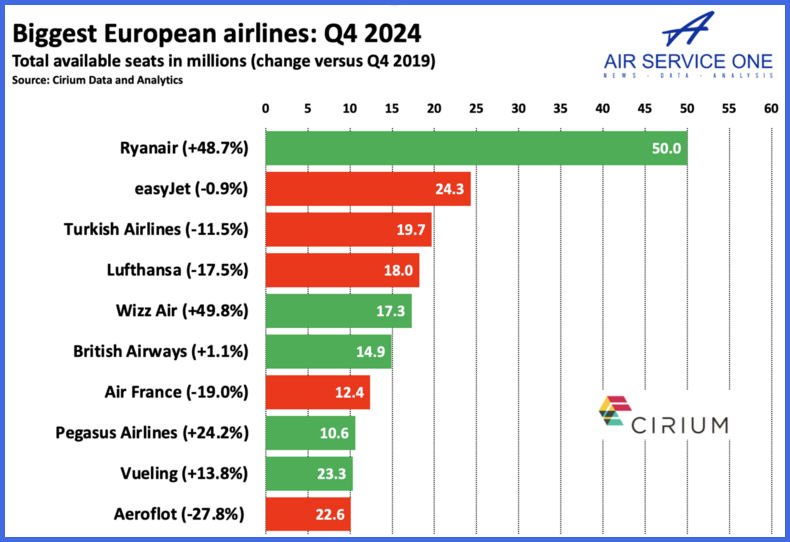
Ryanair is set to remain Europe’s fastest-growing airline in Q4 2024, with its capacity surging by 38.7% compared to five years ago. ULCCs have added more than 11.8 million seats since the pre-pandemic year of 2019, fuelled by strong demand in key markets like Spain and Italy. Additionally, Ryanair has intensified its focus on southeastern Europe, including the launch of winter flights to the Croatian coast this year for the first time, further driving its expansion in the region.
Among Europe’s ten largest airlines, half are low-cost carriers: Ryanair, easyJet, Wizz Air, Pegasus Airlines, and Vueling. In contrast, the remaining five legacy carriers in the top ten are struggling to return to their 2019 capacity levels, highlighting the ongoing challenges these traditional airlines face in keeping pace with the more agile and flexible LCC operators.
As Europe’s airports and airlines welcome another winter season, the data highlights a landscape marked by both significant recovery and emerging challenges. The fourth quarter will push total seat volumes above pre-pandemic levels, driven by sustained demand even amid rising supply chain problems and geopolitical issues. However, the growth dynamic is not uniform across the continent, with some markets experiencing stagnation.
Airlines will need to continue adapting to a complex environment shaped by operational constraints, market demand fluctuations, and external pressures. How they navigate these challenges will determine whether the industry can sustain its recovery and capitalise on the promising trends observed so far.
