Europe-South America passes 10 million departing seats for the first time; Iberia remains the top carrier

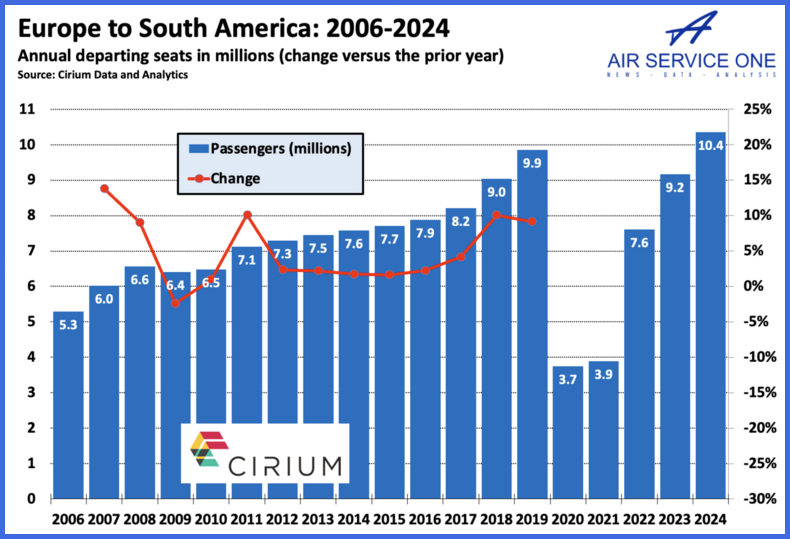
The Europe to South America market has exceeded its pre-pandemic capacity. In 2024, there were 10.4 million seats, the only year to date with 10+ million. It has risen by more than 5% compared to 2019. Many new routes in the past year have helped. Perhaps the most unusual was by Edelweiss, which introduced Zurich-Bogota-Cartagena-Zurich in November 2023 (2-weekly).
Despite the growth, South America is among Europe’s less-recovered intercontinental markets. For example, Australasia is +35% (from a tiny base), Africa +26% (because of North Africa), Central America +15%, Asia +6% (mainly due to India), and North America +6%.
Iberia is the leading non-stop operator, and TAP is number three
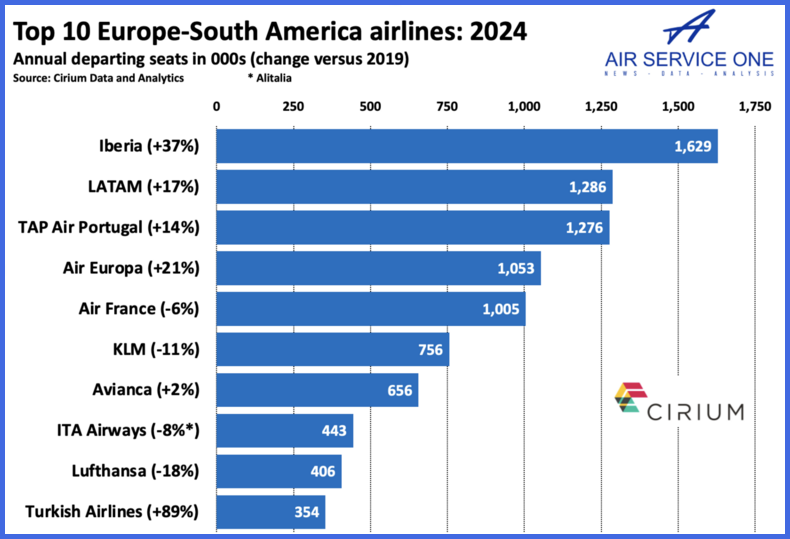
More than 24 airlines have Europe-South America flights, and Iberia is naturally the leading operator. It does not just benefit from the Spanish connection, but also the geographic location of its Madrid hub to feed the continent from across Europe.
Iberia’s share of the market has risen to 16%, but it would be 26% if it is permitted to acquire Air Europa. Iberia serves Bogota, Buenos Aires, Caracas, Lima, Montevideo, Guayaquil, Quito, Rio de Janeiro, Santiago, Sao Paulo GRU. Ignoring any network changes, it would rise to 15 destinations with Air Europa.
TAP is the third-largest carrier, down from second in 2019 and falling behind LATAM. This year, TAP serves 14 South American airports, 13 of which are in Brazil. Strong use of the A321LR has helped, and it has benefited from two additional destinations.
On 3 September, TAP will begin Lisbon-Florianopolis (3-weekly; A330), the first time that city has had European flights. On 4 November, it will start Lisbon-Manaus via already-served Belem (3-weekly A321LR). TAP last served Manaus in 2016, when it operated non-stop in both directions.

Madrid seats have risen by a quarter
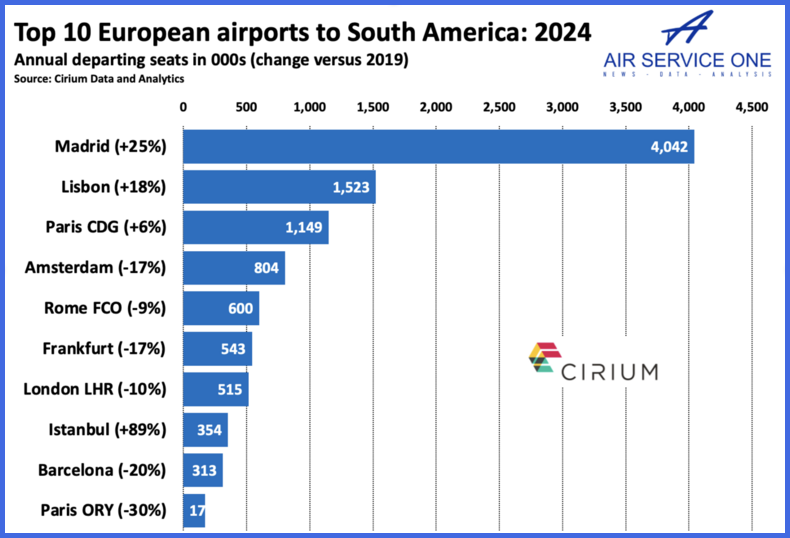
Over 20 European airports have South American flights. More than half of the top 10 have fewer seats than they did in 2019. Not so the already heavily dominant Spanish and Portuguese capitals, with a quarter and nearly a fifth more capacity, respectively.
Madrid has benefited from LATAM’s new Madrid-Bogota route, which began from Europe on 4 July (daily) and begins and ends in Santiago. Elsewhere, LASER started Madrid-Caracas on 4 June (3-weekly). On 1 December, World2Fly will start Madrid-Cali (2-weekly).
Unlike in 2019, London LGW has fallen out of the top 10. Then, Norwegian served Buenos Aires and Rio, while British Airways served Lima. Five years later, LGW is only linked to Georgetown, Guyana, via St Lucia with BA. The airline began the route in March 2023.
Istanbul replaced LGW in the top 10, which now ranks eighth. Turkish Airlines serves Bogota, Buenos Aires, Caracas (some flights are via Havana) and GRU. Buenos Aires flights are via GRU. Turkish Airlines’ big growth compared to 2019 is from densification rather than network expansion.
Madrid-Bogota is the leading market
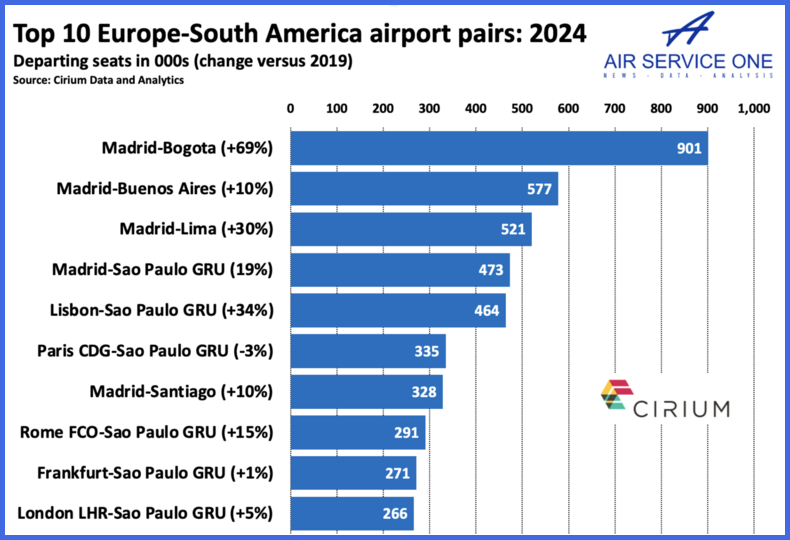
Europe has around 80 South American airport pairs. Madrid-Bogota continues to be number one. It has grown by a considerable 69% compared to 2019. Iberia’s capacity has increased by 145% and Avianca’s by a fifth, while Plus Ultra entered the market in 2022 and LATAM in 2024. In August 2024, there are 67-weekly flights by Avianca (28-weekly), Iberia (21-weekly), Air Europa (daily), LATAM (daily) and Plus Ultra (4-weekly).