


Europe’s winter capacity hits record high

During the upcoming winter season, covering the fourth quarter of 2025 and the first quarter of 2026, Europe is projected to see an almost 7% increase in available seat capacity, reflecting the continued and strong resilience of demand in the context of significant supply pressures, operational disruptions, increasing geopolitical and geoeconomic tensions, as well as renewed macro-economic uncertainties.
According to airline capacity data reported to Cirium, carriers across the continent will offer a record 745,308,665 seats during the period, up 8.8% compared to the last pre-pandemic winter of 2018/19.
LCCs driving strong European winter capacity
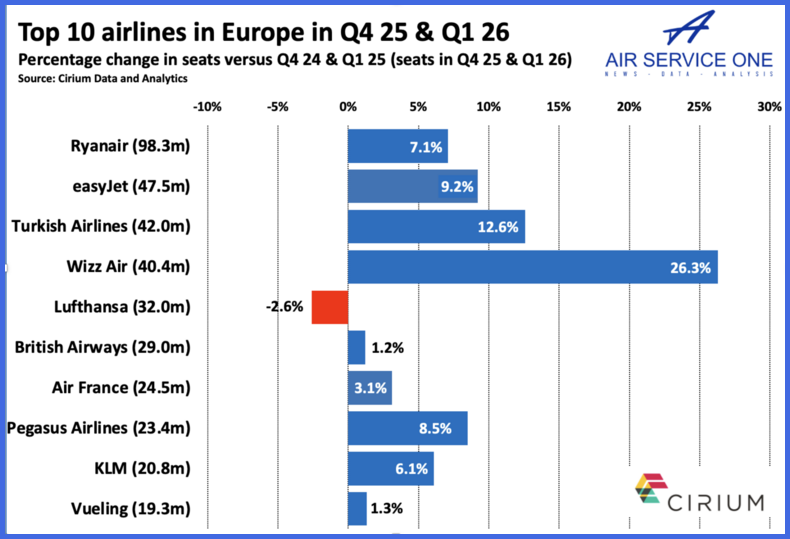
The bulk of this growth is being generated by low-cost carriers (LCCs). Ryanair is set to remain Europe’s largest airline, with more than 98.3 million seats on offer during the two quarters, representing a 7.1% year-on-year increase.
Wizz Air, which had portions of its A320neo fleet temporarily grounded over the past two years due to engine issues, was forced to remove capacity from the market and delay expansion. With these engine problems now being resolved, the airline is resuming strong growth, focusing particularly on Central and Eastern European markets. It plans to boost its overall capacity in Q4 2025 and Q1 2026 by 26.3%, reaching 40.4 million seats.
Capacity gains concentrated in Europe’s South and East
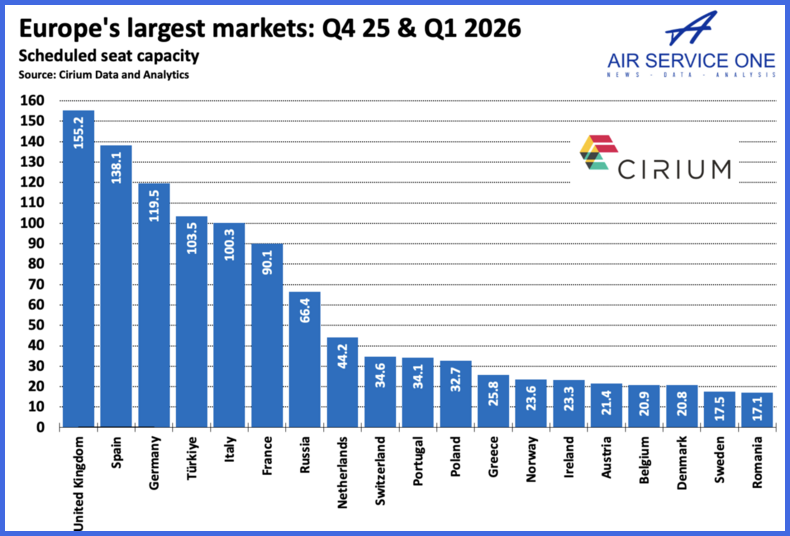
Southern and Eastern Europe remain the primary engines of capacity growth. Markets such as Greece, Italy, Portugal and Spain have surpassed pre-pandemic seat counts, propelled by strong leisure demand.
Many of these destinations are also strategically extending their summer season, with numerous airlines continuing seasonal services well beyond the traditional October cut-off date.

Eastern and Central European countries, including Poland, Hungary, Slovakia and the Balkans, are recording double-digit passenger gains, largely driven by LCC expansion, rising disposable incomes and strong Visiting Friends and Relatives (VFR) travel.
In contrast, Western and Northern Europe are experiencing slower growth. Germany, Norway, Finland and particularly Sweden remain below 2018/19 levels, hindered by the closure of Russian airspace, higher aviation taxes and subdued domestic demand.
The United Kingdom retains its position as Europe’s largest market, with 155 million seats scheduled, up 5.7% year-on-year. Spain follows with 138 million seats, marking a notable 25.3% increase and underlining its growing appeal as an off-season destination.
Overall, Western Europe still accounts for the majority of the continent’s air traffic, representing around 72% of all airline seats. However, its growth has been relatively modest compared to the rapid capacity expansion in Eastern, Central and South-Eastern Europe, which, while smaller in total share, are outpacing the rest of the continent in growth rates.
The European market enters winter with high load factors, steady leisure demand and cautious optimism. Capacity is being strategically allocated to profitable routes, with a clear tilt towards leisure travellers. While macroeconomic and regulatory pressures remain, the industry appears set for a stable growth phase through to early 2026.
