


German aviation market continues its uneven recovery
Germany remains one of Europe’s largest commercial aviation markets, but its recovery since the pandemic has been markedly slower than that of most neighbouring countries.
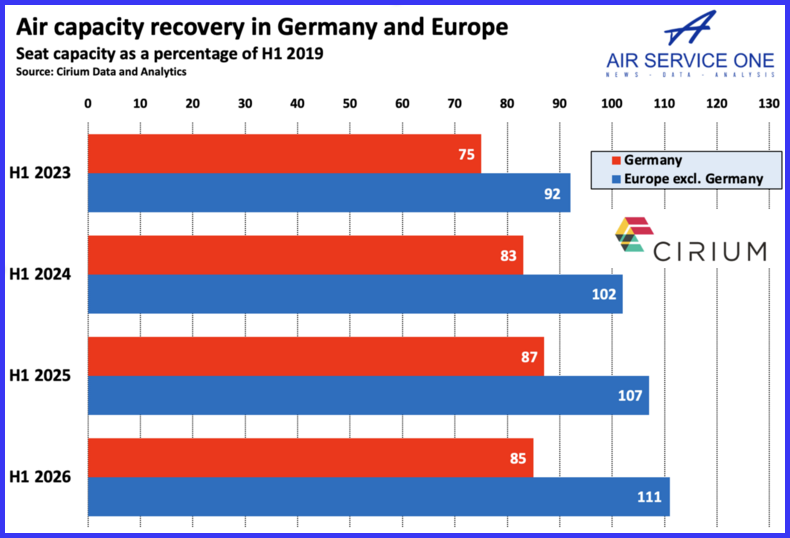
German airports handled 197.2 million passengers in 2023, rising to 211.9 million in 2024 and 219.6 million in 2025. Despite three consecutive years of growth, traffic last year was still around 12% below pre-pandemic levels. The contrast with the rest of Europe has become increasingly pronounced: during the first half of 2026, airline seat capacity in Germany stood at just 85% of the comparable 2019 level, compared with 111% across the rest of Europe.
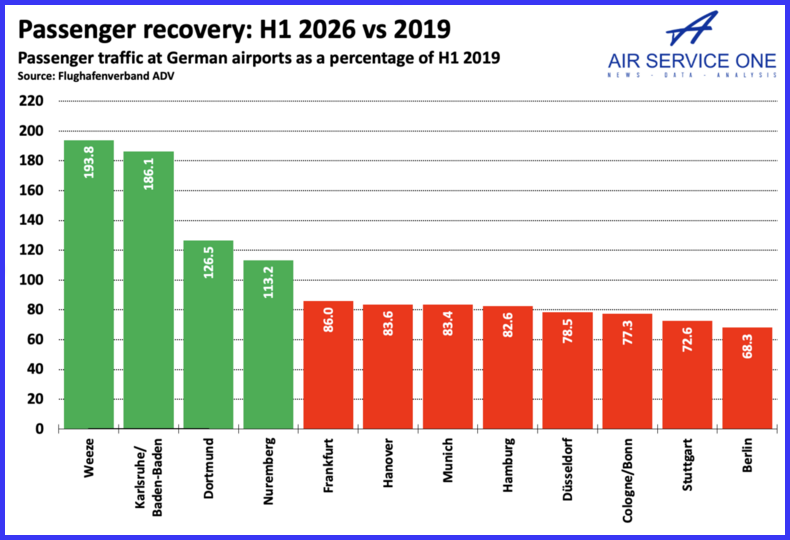
Growth has also stalled in 2026. German airports handled 97.7 million passengers during the first six months of the year, down 0.8% on 2025 and equivalent to 83.2% of the volume recorded during the same period in 2019.
However, the figures mask a considerable divergence between different segments of the market. European traffic has recovered to 93.0% of 2019 levels and intercontinental traffic to 92.4%, while domestic traffic stands at only 47.8%. This represents one of the most important structural changes in German aviation since the pandemic.
Short domestic sectors have been affected by increased rail use, reduced corporate travel and videoconferencing, while airlines have also rationalised feeder networks. By contrast, leisure and visiting-friends-and-relatives demand, particularly to Southern Europe, Turkey, the Balkans and North Africa, has proved considerably more resilient.
The German government has begun attempting to improve the market’s competitiveness, reducing the air passenger tax from 1 July, 2026 to the rates that applied before May 2024. Any substantial impact on airline capacity is likely to take time, since fleet deployment and schedules are generally planned many months in advance.
Gap widens across German airports
The uneven recovery is particularly visible at individual airports. Airports heavily exposed to low-cost and leisure traffic have already moved comfortably above pre-pandemic volumes, including Nuremberg, Dortmund, Karlsruhe/Baden-Baden and Weeze. The very high growth rates at the latter two partly reflect their considerably smaller bases in 2019, but the broader trend shows that secondary airports oriented towards price-sensitive leisure and VFR traffic have generally recovered more quickly than Germany’s larger business and network markets.
Lufthansa Group dominates German market
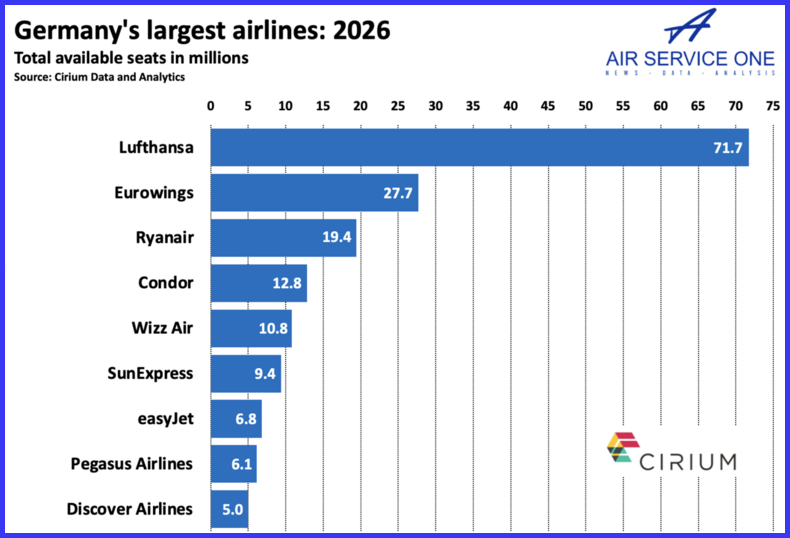
Germany’s airline market continues to be led by Lufthansa, reflecting the scale of its hub operations at Frankfurt and Munich, where its short-haul network feeds an extensive long-haul system. Eurowings occupies a different role within the Lufthansa Group, concentrating on point-to-point, leisure and visiting-friends-and-relatives markets and maintaining a particularly strong presence at airports including Düsseldorf, Cologne/Bonn, Hamburg and Stuttgart.
Ryanair remains Germany’s largest independent low-cost operator, although its German footprint is relatively restrained compared with several other European markets.
Meanwhile, the continued strength of leisure demand has supported expansion by Condor and SunExpress.
Frankfurt: Germany’s global gateway enters a new era
Frankfurt remains comfortably Germany’s largest airport and the centrepiece of the country’s international aviation network. Its importance extends well beyond its local catchment: as Lufthansa’s principal hub, a large proportion of the airport’s traffic is generated by passengers connecting from domestic and European services onto its extensive long-haul network.
Frankfurt handled 63.2 million passengers in 2025, but traffic remains below pre-pandemic levels. During the first half of 2026, the airport welcomed 28.9 million passengers, down 0.8% year-on-year and equivalent to around 86% of its first-half 2019 total. Strikes affecting Lufthansa and disruption caused by geopolitical developments in the Middle East were important factors during the period.
There are nevertheless encouraging signs within Frankfurt’s traffic mix. Long-haul demand to the Far East and Africa grew during the first half of 2026, while July passenger numbers increased 1.4% year-on-year to 6.2 million despite the number of aircraft movements falling 3.2%. Larger aircraft and stronger load factors are therefore allowing the airport to carry more passengers with fewer flights.
Frankfurt also retains an important advantage through its cargo business, handling around one million tonnes during the first half of 2026 alone.
The most significant development at Frankfurt this year has been the opening of Terminal 3. Following an investment of around four billion euros, the facility entered service on 23 April 2026. Its three initial piers provide capacity for up to 19 million passengers annually, while a future fourth pier could increase this to 25 million. Terminal 2 has consequently been closed for a comprehensive refurbishment.
The timing means Frankfurt now has substantial modern terminal capacity available before passenger numbers have fully returned to their previous peak, positioning the airport for longer-term growth once airline supply and Germany’s wider aviation market regain momentum.
