Jetstar is Australia’s 2nd-largest international airline; 40 airports served in Q2
The first flight of Australia’s Jetstar took place nearly exactly 22 years ago, in May 2004. The LCC, which remains a wholly owned subsidiary of Qantas, is now Australia’s second-largest airline by available seats. It also has a relatively small amount of capacity deployed within New Zealand.
According to Cirium schedule data, Jetstar has almost 7.1 million two-way seats in Q2 2026 (April-June), which is a record for that period. Of this, some 6.4 million – around 90% – is to, from, or within Australia.
Jetstar’s capacity has risen by 3% compared to the prior high, which was in Q2 2025. It provides a fifth of Australia’s seats (20%), which jumps to a quarter for the domestic market (25%). It is Australia’s third-largest domestic airline, but second for international activity.
Jetstar now has just under 1.8 million international seats, equivalent to 28% of its total offering. That’s two percentage points higher than its previous highest proportion. This has been aided by strong year-over-year growth (Q2 capacity is up 11%), while the domestic market has experienced a small decline.

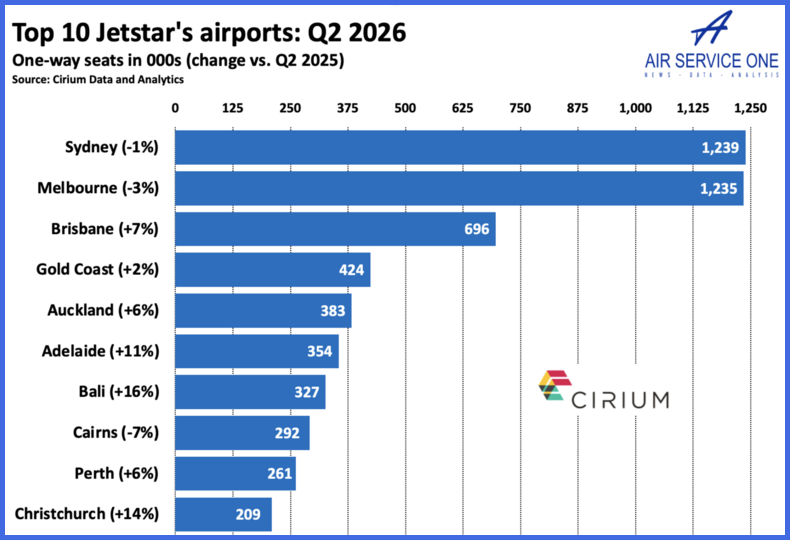
Sydney has overtaken Melbourne as Jetstar’s top airport
The LCC will serve 40 airports in Q2, of which 21 are domestic and 19 are international. Compared to the same three months last year, Cebu and Manila have joined its network. It had not previously flown to either place in the Philippines.
Sydney is neck-and-neck with Melbourne for Jetstar’s most-served airport, but it just about exceeds it. A year ago, Melbourne was first. Unsurprisingly, Sydney is the airline’s top airport for domestic operations, but it is second, behind Melbourne, for international activity. That is driven by Sydney being Qantas’ main hub.

Jetstar has 28 routes from Sydney in the examined period. Unlike in Q2 2025, no route has joined the LCC’s network. However, it no longer serves Hamilton Island or Honolulu; they’re now in the exclusive hands of Qantas.
Jetstar has 114 routes in Q2
Its network consists of 63 domestic and 51 international routes. Unlike April-June last year, these additional markets are now served or will be soon. Frequencies relate to mid-June 2026.
- 1 August 2025: Gold Coast-Bali (3-weekly)
- 21 October 2025: Newcastle-Bali (4-weekly; on 24 March 2025, flights were extended to Singapore)
- 27 November 2025: Perth-Manila (3-weekly)
- 1 December 2025: Christchurch-Hamilton (daily)
- 2 December 2025: Newcastle-Hobart (seasonal; flights return in October; 3-weekly)
- 3 December 2025: Brisbane-Cebu (3-weekly)
- 23 March 2026: Melbourne AVV-Bali (5-weekly)
- 25 March 2026: Sunshine Coast-Bali (3-weekly)
- 26 March 2026: Adelaide-Melbourne AVV (5-weekly)
- 18 May 2026: Brisbane-Rarotonga (3-weekly)
- 15 June 2025: Brisbane-Queenstown (3-weekly)
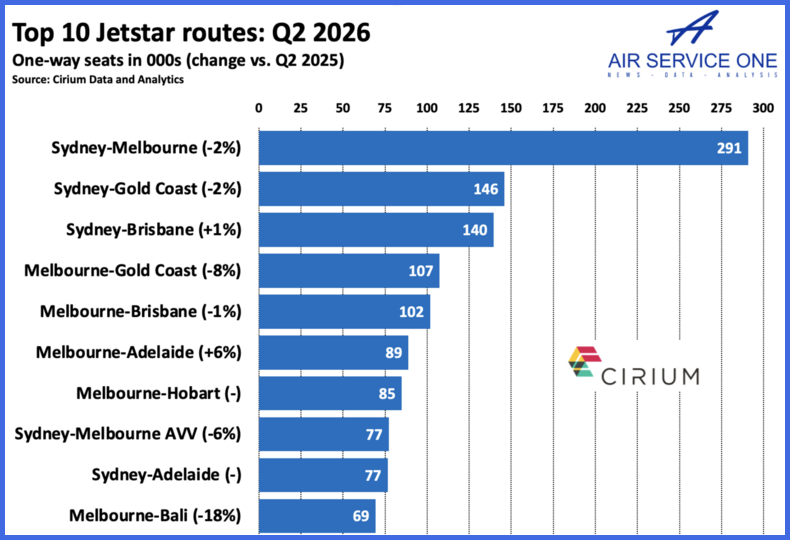
With 291,000 one-way seats, Jetstar’s most-served route is Sydney to Melbourne. Given this links Australia’s two most populous cities, that is hardly surprising. It is the third-largest airline, behind Qantas (429,000 one-way seats) and Virgin (387,000).
In mid-June, Jetstar has 105-weekly departures each way, against Qantas (201) and Virgin (161). In the past, various other airlines have served this city pair, including the OzJet (until 2006), Tigerair (until 2020) and REX (until 2024).