


London Luton Airport eyes record growth, new markets and expansion
London Luton Airport (LTN) is closing out another exceptionally strong year, edging closer to its pre-pandemic performance and setting the stage for its continued growth.
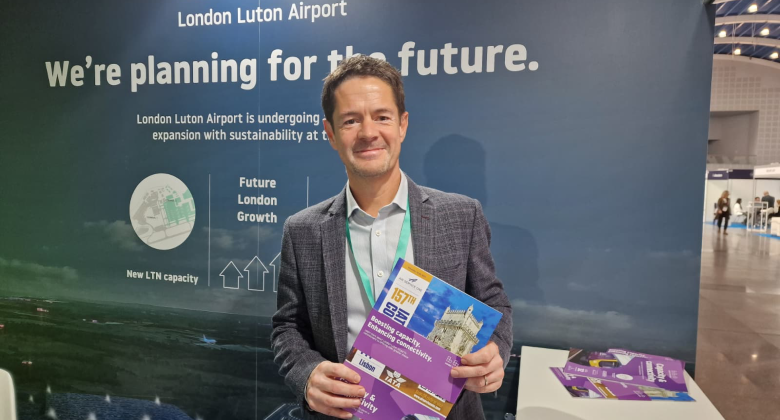
Speaking to Air Service One at the 157th IATA Slot Conference in Lisbon, Simon Harley, Interim Director of Aeronautical Revenue at London Luton, commented: “It’s been an exceptionally strong year for London Luton Airport. Passenger numbers continue to grow, reflecting both market resilience and the confidence airline partners have in LTN,” Harley said.
He added that recovery has been fuelled by the airport’s core carriers, including easyJet, Wizz Air and Ryanair, as well as the hugely successful launch of Jet2’s base earlier this year and the rise of niche and seasonal operators. The focus now, he noted, is on “driving more responsible growth through efficient operations and continued focus on the passenger experience.”
Strengthening Europe’s connectivity
Despite having one of the most extensive European networks in the UK, LTN sees considerable room for additional growth.
According to Harley, “Europe remains at the heart of our network, but there’s still untapped potential.”
He highlighted opportunities to reinforce connectivity in Central and Eastern Europe, historically strong markets for LTN, as well as to rebuild capacity into key Western European countries such as Italy, France and the Nordics.
“We’re working with airlines to identify emerging leisure and VFR demand patterns, particularly to secondary cities that are well suited to narrowbody, high-utilisation operations,” he said.
Opportunities beyond Europe
LTN also sees promising prospects in regions just beyond Europe. “We see opportunities in both the Middle East and North Africa,” Harley stated. “LTN already serves a diverse and globally connected passenger base, and the demand profile supports selective expansion into these regions, especially for leisure passengers and those travelling to visit friends and family.”
He confirmed that the airport is engaging with several partners to explore potential new routes and capacity increases.
On whether LTN could once again attract long-haul leisure services, he offered a cautious but optimistic view: “As aircraft technology evolves, we’re seeing the opportunity improve significantly, particularly with new-generation narrowbodies offering extended range. We do anticipate a broader range of mid-haul narrowbody routes becoming feasible from LTN in the coming years.”
Universal Studios and East West Rail
Two major infrastructure projects are set to reshape the region surrounding the airport: the newly announced Universal Studios theme park project and the East West Rail railway connection. Harley described both initiatives as highly promising.
“The development of the Universal Studios theme park will bring a transformational economic boom to the region. It will be a major driver of inbound tourism, and our prime location provides the perfect neighbouring gateway for passengers travelling from Europe, the Middle East and beyond.
“Meanwhile, the East West Rail connection is set to transform accessibility to the airport, expanding our catchment and improving connectivity across the Midlands and beyond.”
Competing in Europe’s densest aviation market
Situated in one of the world’s most competitive aviation catchments, LTN relies on agility, efficiency and a strong value proposition to stand out. “Competition in the London market is intense, but LTN’s advantages lie in its agility, simplicity, and strong value proposition for both passengers and airlines,” Harley explained.
He pointed to recent developments, including the Luton DART and Luton Airport Express rail links, a £20 million investment in next-generation security screening technology, and upgraded retail and hospitality spaces.
LTN was recently named the UK’s best airport for low-cost airlines by Skytrax and ranked among the top ten airports globally in the same category. This year, four out of five passengers rated their experience as “very good” or “excellent” in the ASQ benchmarking programme.
LTN’s focus on delivering a consistently positive passenger experience is clear. Recent highlights over the past year include becoming the first UK airport to achieve Level 3 of the Airports Council International (ACI) Customer Experience Accreditation and achieving the BSI Kitemark for Service Excellence certification – another first for a UK airport.
“Our award-winning, simple and friendly passenger experience is something that we feel sets us apart,” Harley added. “Our focus is on being the smart choice for airlines looking for efficient operations and fast turnaround capability in the London system.”
LTN’s second terminal
In April, development of Luton’s long-term future took a major step forward when the airport’s owner, Luton Rising, secured a Development Consent Order (DCO) for expansion.
“The DCO granted earlier this year is a major milestone. It allows the airport to expand and develop infrastructure, paving the way for the airport’s annual capacity to rise from 18 million passengers per year to 32 million,” he said. “The plan includes new terminal infrastructure, taxiways, stands, and improved surface access, all designed to enhance operational efficiency and passenger experience.”
Importantly, the expansion will be governed by strict environmental commitments. Harley noted that the project will adhere to “a legally binding and independently monitored framework with limits on noise, airport carbon emissions, air quality and surface access under a ‘Green Controlled Growth’ model, to ensure more responsible growth.”
Harley emphasised the broader economic impact: “Commercially, this represents a transformational opportunity to diversify our routes and airline offering, supporting long-term growth for both the airport and the local economy.”
