Massive changes at Billy Bishop Toronto City; most seats since 2022 with Air Canada’s international flights
Billy Bishop Toronto City Airport (IATA code YTZ) has a very enviable location. It is just three kilometres from the downtown core of what is by far Canada’s most populous city. Situated on Toronto Island, it is accessed by ferry or the pedestrian tunnel.
YTZ’s location means that the runways are very short. The maximum length is just 3,988 feet (1,216 metres), which limits aircraft usage, with jets still banned. It also has a strict curfew, with movements prohibited between 23:00 and 06:45. It suffers from weather-related challenges during the winter. However, it has a US preclearance facility, which is major factor in YTZ’s development.
Approximately 1.7 million passengers were welcomed in 2025, which was down from two million in 2024 and was 39% lower than the best year to date. In March 2026, Air Canada Express started flying internationally from YTZ – driven by the preclearance facility. Cirium schedule data shows the airport has 923,000 two-way seats in Q3 2026 (July-September), which is the highest volume since 2022. This may help to support YTZs future expansion plans.
Propair arrived in 2026
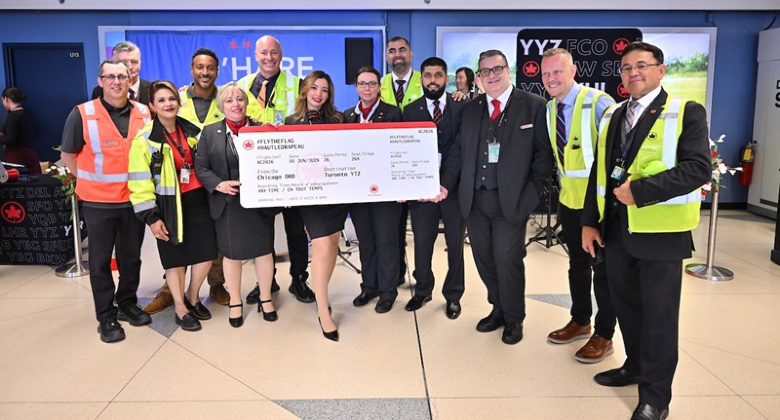
Three scheduled carriers serve YTZ: Air Canada Express, Porter and Propair. The latter airline debuted on 23 February 2026, with a 4-weekly service from Rouyn-Norlanda (Quebec) via North Bay (Ontario). The route, which uses the Beech 1900, covers a total of 505 kilometres each way. Propair uses a FBO rather than the normal terminal.
Porter has served YTZ since the regional carrier’s inception in 2006. The facility was utterly critical to the airline’s existence for years. Between 2006 and 2022, Cirium data shows that 84% to 97% of its capacity was deployed there. Since 2023, Porter has expanded elsewhere, including Toronto YYZ, primarily due to the airline’s E195-E2s. In 2026, just a fifth of the operator’s capacity is to/from YTZ, and it is now the third most-served airport.
Air Canada pulled out of Toronto’s downtown airport in 2006, when it operated from the Canadian capital, Ottawa. The airline returned in 2011 and flew exclusively from Montreal until the Ottawa route reemerged a decade later.
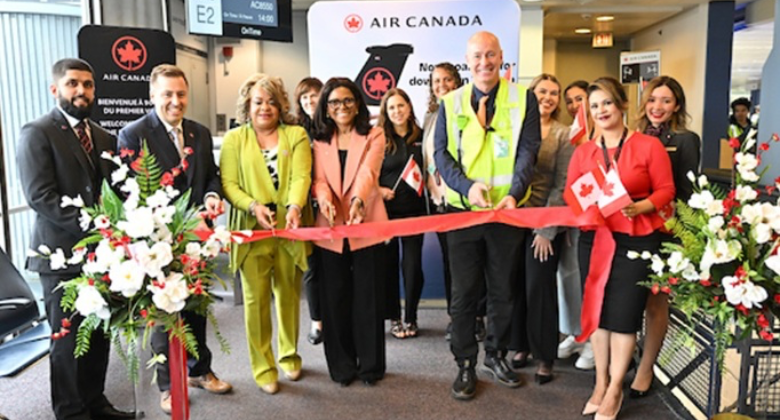
Cirium shows that Air Canada has 349,000 two-way seats in Q3 2026, which is the most capacity in any quarter to date. Excluding prior quarters this year, it exceeds the previous record by 64%. This growth is because of the airline’s international activity, with four routes operational or upcoming, as shown below. All but one competes head-to-head with Porter. The exception is New York LGA, with Porter serving Newark instead.
- 29 March 2026: New York LGA (4-daily)
- 1 June 2026: Chicago ORD (2-daily)
- 1 June 2026: Washington IAD (daily)
- 1 July 2026: Boston (3-daily)

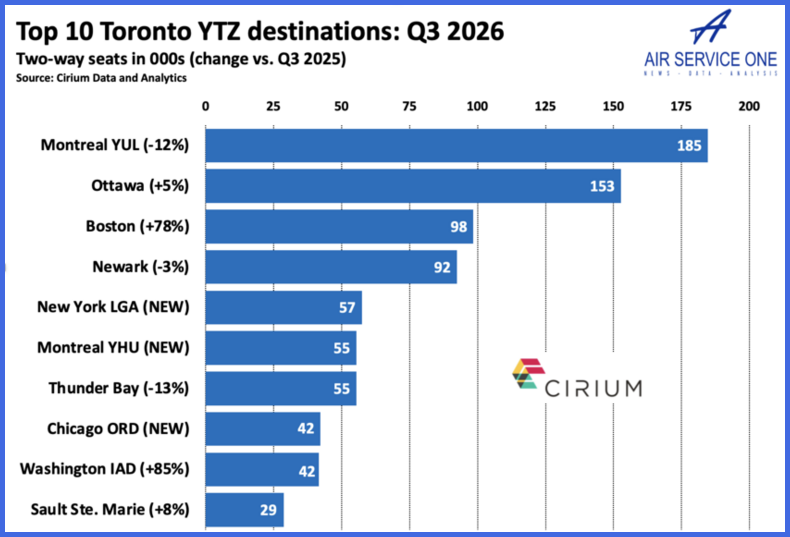
Montreal is the leading market
According to Cirium, 346,000 of YTZ’s 923,000 seats in Q3 are international, which is the highest amount in the peak summer since 2019. However, capacity remains down by 9% compared to the record, which was held in 2017. In contrast, domestic seats are at their lowest level since 2010 (excluding the pandemic-driven 2021).
YTZ has non-stop and one-stop flights to 20 destinations. 14 are domestic and six are international. With 185,000 two-way seats, Montreal is the leading market. 90-weekly outbound flights are available in July, provided by Air Canada (59) and Porter (31). The pair compete directly to five destinations in Q3.