


Middle East markets among world’s fastest growing

The Middle East has emerged as a pivotal player in the global aviation industry, characterised by its strategic geographical location, rapid economic growth, and ambitious investments in airline infrastructure. It is now one of the fastest growing markets in the world.
As demand for air connectivity continues to recover and grow, the region’s major carriers – Emirates, Qatar Airways, and Etihad Airways – have positioned themselves as leaders in long-haul travel but face a challenge from SAUDIA and its new counterpart Riyadh Air, as well as a resurgent Gulf Air in Bahrain.
Ongoing geopolitical issues in the region continue to impact the aviation sector this year in Israel, Lebanon, Jordan, Iran, Syria, and Yemen.
UAE and Saudi Arabia lead Middle East capacity
In 2004, the Middle East ranked globally as the seventh largest region with 114 million seats per year. This year expectations are for 426 million.
Whilst two markets dominate – the United Arab Emirates (UAE) and Saudi Arabia – their market structures are very different. In Saudi Arabia, 30% (35.7 million) of seats are operated on domestic services, whereas international capacity accounts for 100% of the UAE market. Together, these two country markets account for 70% of all airline capacity in the region, and when Qatar is added in third place the top three are responsible for 85% of all capacity in the region.

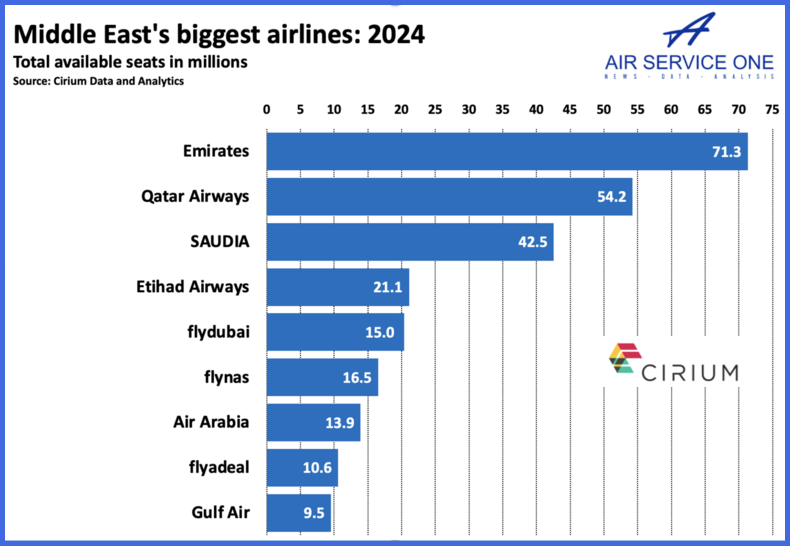
Emirates is the Middle East’s largest carrier
Aligned with market expansion, the number of airlines operating in the Middle East has grown significantly since the start of the 21st century. In 2000, there were 135 scheduled airlines serving the region, a figure that peaked at 213 carriers by 2023.
Since as early as 2000, several locally based airlines, such as SAUDIA, Emirates, and Oman Air, have been actively operating throughout the first quarter of the century. Despite being established later, both Etihad Airways, founded in 2003, and flydubai, launched in 2009, have quickly risen to rank among the top five carriers in the region based on capacity.

The emergence of LCCs in the region has also had a significant impact on the aviation landscape in the Middle East, facilitating more frequent travel and adding a new base of customers to the sector. The largest among them is the Sharjah-based Air Arabia, which has since branched out to establish subsidiaries in Morocco, Abu Dhabi, Egypt, and Jordan.
Saudi Arabia, where over 60% of the population is under the age of 30, has seen growing demand for travel, particularly domestically, as the country opens up to international tourism. New Saudi LCCs flynas and flyadeal have been established in the past two decades, positioning themselves within the Middle East’s top ten largest and overtaking legacy flag carriers such as Kuwait Airways, Oman Air, and Middle East Airlines.

Indian carriers dominate as the Middle East’s largest non-domicile airlines, primarily serving for the large expatriate community from the subcontinent living in the region, particularly the Gulf states of the UAE, Saudi Arabia, and Qatar. On the other hand, Türkiye’s Turkish Airlines and Pegasus Airlines are the largest from Europe based on available seat capacity on Middle East markets.

Geopolitics hit Middle East’s aviation sector in 2024
In 2024, the Middle East’s aviation market is being challenged by escalating geopolitical tensions, particularly the Israel-Gaza conflict. The recent intensification of hostilities, including an attack on Israel by Iran and ongoing skirmishes between Israel and Lebanon, has led to substantial disruptions in air travel across the region.
Many carriers have been forced to suspend flights temporarily, while airspace closures and reroutings have become more frequent, complicating flight operations and increasing costs. In 2024, Israel’s total available seat capacity has decreased 34.1% year-on-year, with the fourth quarter of 2023 also impacted by the ongoing conflict. This has had a spillover effect on other markets in the region, including Lebanon, which has 8% less capacity than last year.
Iran’s aviation sector, despite serving the region’s largest population, continues to struggle under the weight of international sanctions, severely limiting its growth potential. Similarly, the aviation markets in Syria and Yemen remain crippled by years of civil war and unrest.
Saudi Arabia targets 300 million passengers by 2030
Saudi Arabia’s Vision 2030 is set to disrupt the dynamics of the Middle East aviation market. The much-touted start-up Riyadh Air, which has already set a goal of competing with the likes of Emirates and Qatar Airways, is set to launch in 2025.
Vision 2030 plans to turn an oil-dependent economy into a major service and tourism-based economy and has spawned significant investment in the aviation sector in the Kingdom, including airports and airlines.
The country is targeting to reach 300 million air passengers by 2030, 100 million of whom will be tourists. This is an ambitious target considering Saudi Arabia is estimated to handle some 107 million travellers this year. Having access to a domestic market of nearly 43 million passengers annually provides a solid base, however, achieving that target will require levels of international capacity growth never seen in any other country.
Saudi Arabia will need to increase capacity by over 20% per year through to 2030 to achieve its target, a level of growth three times higher than the average since 2010 through 2019 and the pre-pandemic levels.
