


North America capacity growth slows amid supply chain issues

The three major markets in North America – the United States, Mexico, and Canada – are poised for another record-breaking start to the Northern Hemisphere winter in the fourth quarter. However, capacity remains constrained, with growth continuing at a slow pace due to ongoing supply chain challenges.
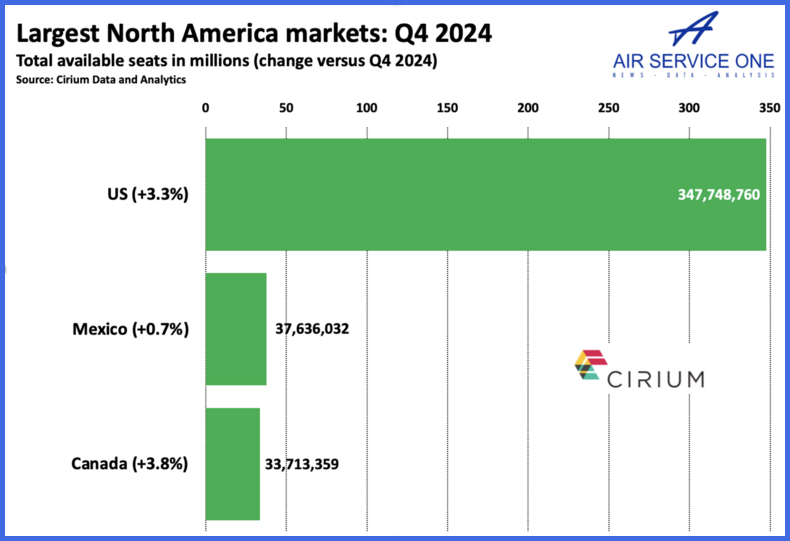
An analysis of data provided to Cirium reveals that the North American market will have a record 395,252,079 seats available in Q4, marking a 3.3% increase over the same period last year and a 6.9% improvement on the pre-pandemic 2019. The US, driven by the busy Thanksgiving travel season, dominates the continent’s capacity with 347,748,760 seats, followed by Mexico with 37,636,032 seats and Canada with 33,713,359 of available capacity.
Compared to the same winter quarter in 2023, the US market is set to grow by 3.6%, while Mexico’s growth will slow to just 0.7%. Canada, despite the collapse Lynx Air and Canada Jetlines, is expected to see a 3.8% increase in capacity.
Mexico faces capacity crunch
Mexico surpassed Canada as North America’s second-largest market behind the US last year and will retain this position during the winter Q4. With 37.6 million seats available, Mexico’s capacity is up by a significant 18.6% compared to Q4 2019 but shows only a modest 0.7% growth year-on-year.
The primary reason for this sluggish growth is ongoing engine issues affecting Airbus neo models, which require inspections and have particularly impacted the rapidly expanding LCC Volaris.
Canada yet to reach pre-pandemic figures
Canada’s aviation sector has yet to return to pre-pandemic capacity levels in Q4 2024. With 33.7 million seats on the market, the country has seen a 3.8% increase compared to last year, but this figure remains 1.9% below the capacity recorded in the same period in 2019.

The recent loss of two Canadian carriers, Lynx Air and Canada Jetlines, which together accounted for over 500,000 seats in Q4 2023, will not significantly impact Canada’s year-on-year growth rate. This gap has largely been filled by foreign carriers, which have expanded their operations to Canada in response to the recovering demand for travel following the stringent pandemic restrictions of the past few years.
US carriers dominate North American market
Out of the ten largest airlines on the continent based on available capacity in Q4, eight are from the US. The three largest legacy carriers – American, Delta, and United – commonly referred to as the US Big Three hold 46.5% of North America’s total capacity in Q4. All three will boast a record number of seats on the market, outstripping their pre-pandemic performance.
The strong growth by legacy carriers in the US has been buoyed by transatlantic travel, with US consumers flocking to destinations across Europe on the back of a strong US dollar. Business travel is picking up too with corporate bookings up on average 14%. Loyalty programs continue to separate business models, paying outsized dividends for the Big Three.
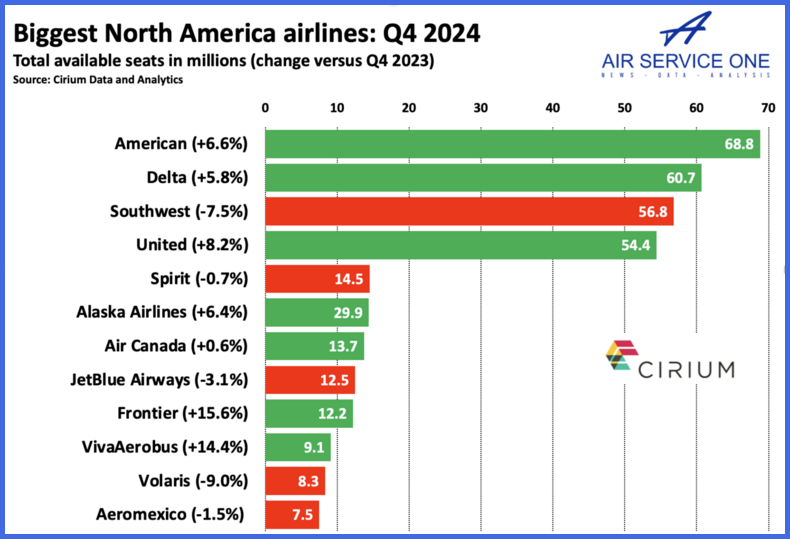
On the other hand, airlines in the US have been unable to escape ongoing issues by suppliers, including aircraft manufacturers. Southwest Airlines is cutting capacity and reevaluating its full-year financial outlook because of fewer expected aircraft deliveries from Boeing. Southwest expects Boeing to deliver 46 737 MAX 8 planes this year, down from the initially planned 79.
ULCC Spirit Airlines has been impacted by manufacturing issues on Pratt & Whitney engines, which has resulted in the grounding of over 40 Airbus neo aircraft this year for mandatory inspection.
