


North America to Maintain Modest Growth in 2026

The North American aviation market is set to record further growth in 2026, supported by resilient passenger demand, particularly in international and leisure segments.
However, expansion will be uneven across markets, with the United States driving most absolute capacity growth, Canada experiencing selective and more cautious expansion, and Mexico continuing to grow while navigating long-standing structural bottlenecks.
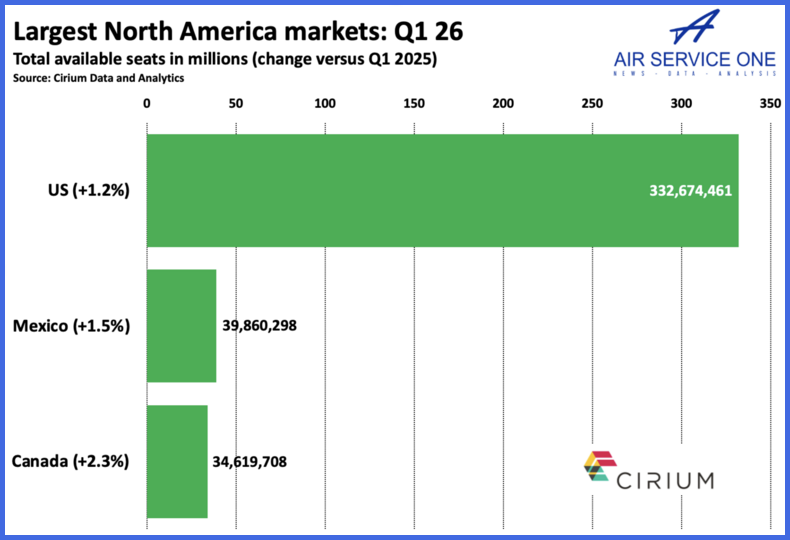
The US is expected to account for the largest share of capacity growth in North America in 2026. In Q1 alone, it has over 332 million seats on the market, according to data by Cirium, up 1.2% year-on-year.
Capacity growth in the US will be concentrated at major hub airports and international gateways capable of supporting additional long-haul and connecting traffic.
In Canada, domestic capacity is projected to increase modestly, supported by stable demand between major metropolitan areas.
In contrast, capacity between Canada and the US is expected to remain volatile, with airlines showing greater discipline in deploying transborder capacity, particularly during the winter season. Capacity between the two countries is down 9.6% during Q1 2026.
Mexico’s aviation market is expected to continue expanding in 2026, driven by strong domestic demand, a large VFR segment and sustained interest from international leisure markets. However, growth remains uneven due to capacity constraints in the country’s capital.

Transatlantic traffic to drive airline growth
US airlines are expected to continue prioritising international flying in 2026, particularly across the North Atlantic, where yields remain strong and premium demand resilient. Delta has positioned summer 2026 as one of its largest transatlantic seasons to date, while United continues to expand its European network with new routes to secondary destinations, complementing its established hubs at Newark, Chicago and Washington.
Domestic capacity growth in the US will be more measured. Network carriers are expected to focus on frequency optimisation rather than broad network expansion, while low-cost and carriers remain constrained by delayed aircraft deliveries and engine issues.
Air Canada is set to play a central role in shaping the Canadian market in 2026. The airline plans its largest annual intake of aircraft to date. The introduction of the Airbus A321XLR will provide new flexibility, allowing Air Canada to serve thinner long-haul routes and expand transatlantic coverage. At the same time, continued fleet simplification within Air Canada Rouge will support cost control and operational efficiency.
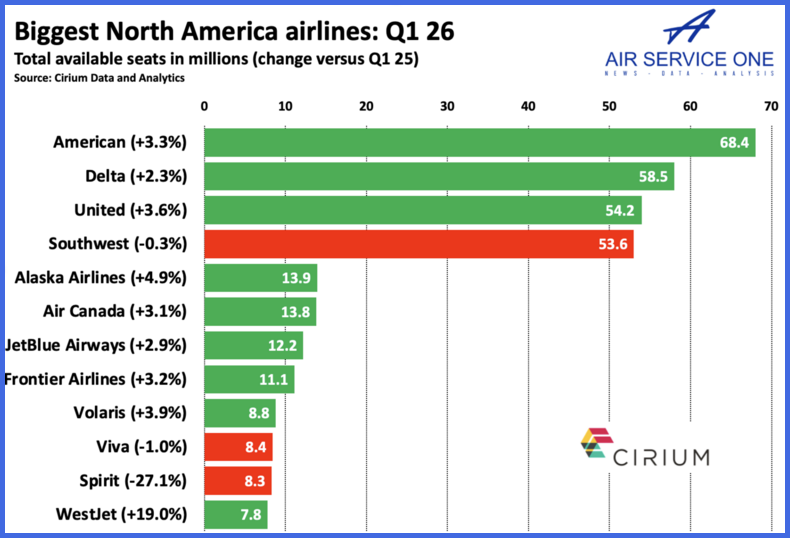
Canada’s WestJet is expected to continue expanding its international network, particularly across the Atlantic, while maintaining a cautious approach to US leisure markets.
In Mexico, Aeromexico is expected to pursue a strategy focused on upgauging rather than frequency growth on constrained routes, particularly to the US. The carrier is also continuing to diversify its long-haul network, adding select European destinations to strengthen hub connectivity and revenue mix.
Low-cost carriers, led by Volaris, will remain central to Mexico’s capacity growth, particularly in domestic and transborder markets. Rivals Volaris and Viva have announced a merger, which is due to close in 2026. The two airlines claim that the new group approach will drive down costs for passengers and strengthen connectivity in Mexico.
