


North American capacity slips as US weakness offsets Mexico, Canada gains

After years of post-pandemic growth, total airline seat capacity across the US, Canada and Mexico is set to slip into a marginal decline during the winter fourth quarter of 2025 and first quarter of 2026.
Slower GDP growth in the US and Canada, high interest rates and a strong US dollar hurting inbound tourism have tempered demand. Airlines are proactively cutting weaker flights rather than risk triggering fare wars.
The region boasts 761,264,921 seats over the six-month period, according to Cirium data. This marks a 0.6% year-on-year decline.
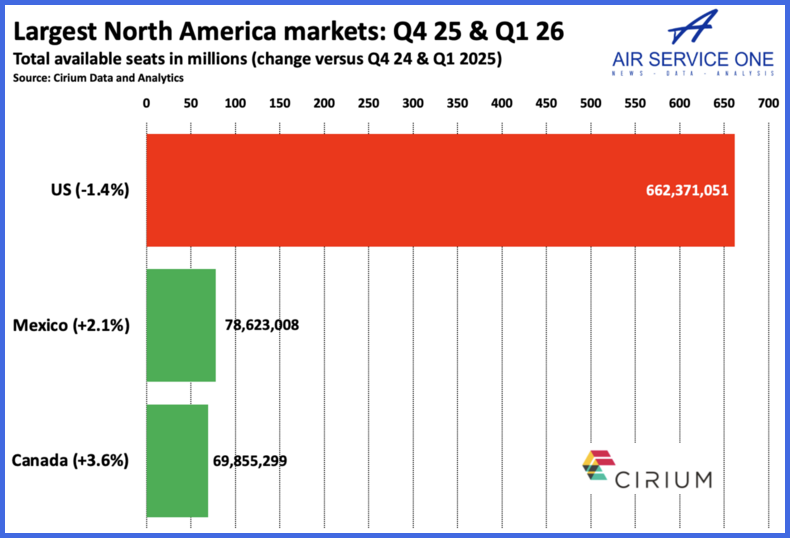
The US dominates the region’s capacity, accounting for 662,371,051 seats. Mexico follows with 78,623,008 seats, while Canada contributes 69,855,299 seats.
Compared to Q4 2024 and Q1 2025, the US market will slump by 1.4%, while Mexico and Canada will grow by 2.1% and 3.6% respectively.
Domestic capacity and transborder travel impacting US
The US still dominates North American air travel, but its domestic market, over 76% of total capacity, is showing softness. Over the two quarters, airlines, primarily low-cost carriers (LCCs), plan to trim domestic seat supply by 2.8% year-on-year, citing weaker yields and a need to restore pricing power.
Transborder routes to Canada have been impacted by ongoing economic tensions between the two countries. Although US carriers have maintained capacity, their Canadian counterparts have redirected some US services to “sun” destinations in the Caribbean and Central America. Overall, transborder capacity will be down 3.8% over the winter period.

In contrast, domestic demand in Mexico remains strong, supported by LCC expansion and steady tourism flows. However, even Mexico’s growth can’t offset declines in the much larger US domestic market when looking at the North American total.
US ‘Big Three’ maintain growth and remain the region’s largest
Airlines in North America are entering the final quarter of 2025 and first quarter of next year in a more cautious operating mode, balancing strong leisure and Visiting Friends and Relatives (VFR) demand against lingering weakness in business travel and macroeconomic headwinds.
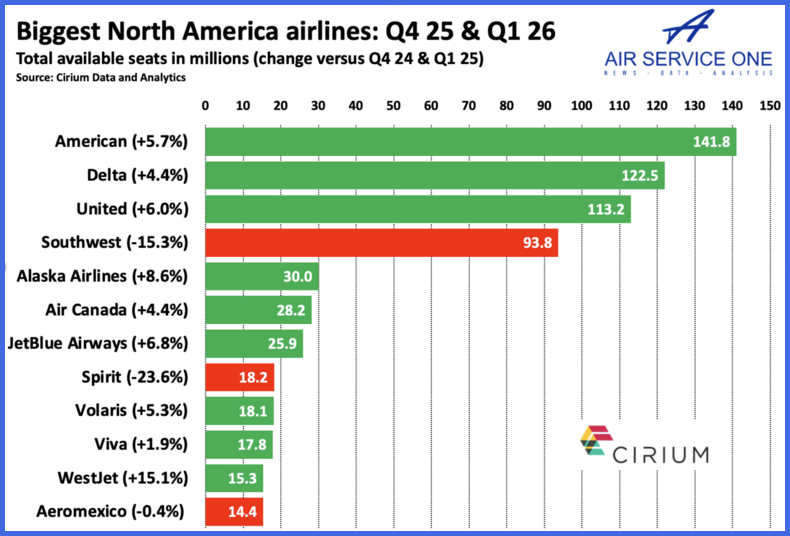
The US Big Three, American, Delta and United, are focusing on yield management, trimming domestic frequencies while growing high-performing international routes.
US LCCs such as Southwest, Spirit, Frontier and Allegiant, continue to struggle, faced with financial issues, restructuring and delays in aircraft deliveries, impeding growth.
In Canada, Air Canada is keeping a tight rein on home market capacity, while WestJet is redirecting seats to overseas sun destinations. Meanwhile, Porter continues its strong expansion with new regional jets.
Mexico’s leading carriers – Volaris and Viva – remain in growth mode, adding domestic and transborder flights.
All operators are contending with aircraft delivery delays, airport slot limitations and a shifting demand mix that rewards agility over sheer scale. After two years of rapid expansion, North American airlines are entering a period of strategic restraint, prioritising yield and profitability.
