

North American growth slows as airlines prioritise profitability

North America’s commercial aviation market enters the 2026/27 winter season with a more cautious outlook than in recent years, amid resilient passenger demand, higher costs and an increasing focus on profitability rather than capacity expansion. The picture is also increasingly uneven across the United States, Canada and Mexico.
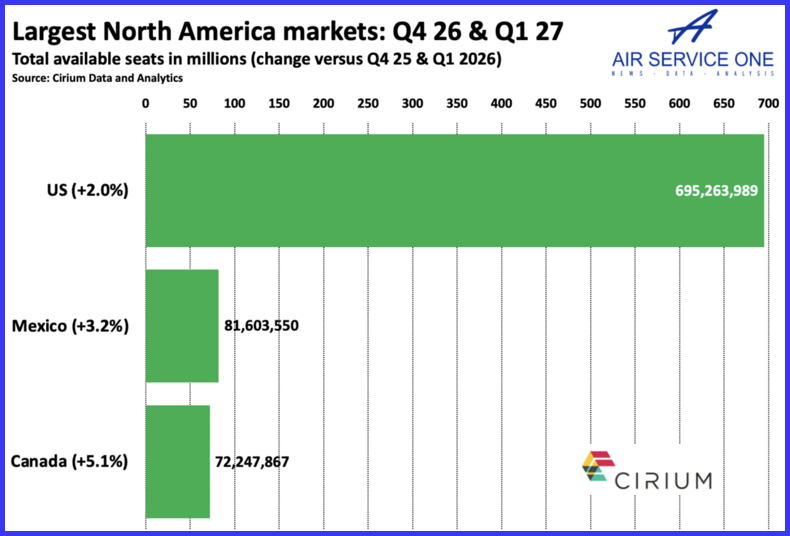
The US, by far the region’s largest market, is entering winter with relatively little overall capacity growth. According to Cirium schedule data, in Q4 2026 and Q1 of 2027 it has 695.3 million seats available, up 2% year on year. Mexico follows with 81.6 million seats, marking a 3.2% increase, while Canada records 72.2 million seats over the six-month period, representing a 5.1% rise.
Network carriers strengthen their position
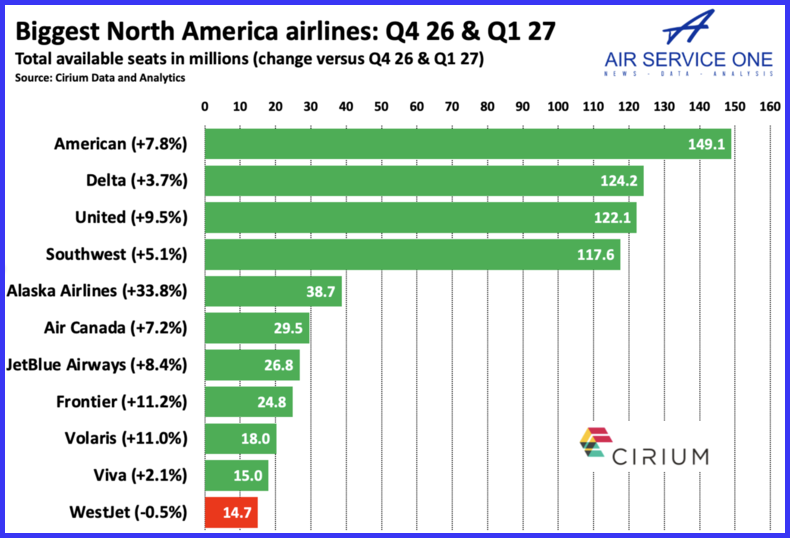
A growing divide between the large network airlines and the low-cost sector will remain throughout the winter. Network carriers are better placed to absorb higher costs through premium products, loyalty programmes and fare segmentation.
This winter will be the first without Spirit Airlines, which ceased operations earlier this year. During the previous winter season, Spirit ranked as North America’s eleventh-largest airline by seat capacity. Although Frontier was initially expected to be the main beneficiary of Spirit’s exit, it has also been forced to scale back capacity as it seeks to strengthen its financial position. Its capacity will still grow by double digits, but by less than originally projected.
Demand remains resilient, particularly among premium and higher-yielding travellers. Delta and United have reported strong booking trends, while United has noted that transatlantic seasonality is continuing to ease, with strong demand increasingly extending into October and November.

Canadian capacity shifts south
Airlines in Canada have increasingly redirected winter capacity away from the US towards Mexico, the Caribbean and Central America.
Earlier this year, Canadian airline capacity to the US fell sharply as demand patterns changed, while WestJet and Air Canada expanded their sun networks.
That strategy will continue this winter, with WestJet serving 50 sun destinations and Air Canada increasing Latin American flying. Porter is also becoming a larger competitor in the leisure market, increasing its sun capacity by more than 150% for winter 2026/27.
Mexico, meanwhile, remains the strongest growth market of the three domestically. Domestic capacity was up 5.8% year-on-year through Q4 and Q1, with Volaris expanding particularly rapidly. However, the international picture is less uniform: US – Mexico capacity will be down 2.9%, during the same period.
