Poland takes off as one of Europe’s fastest-growing aviation markets
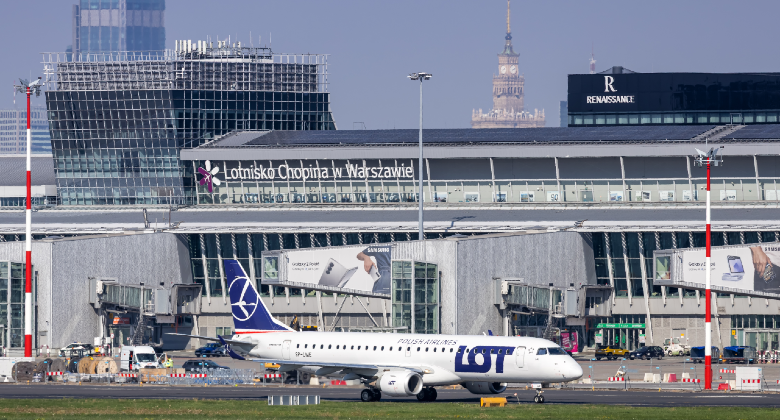
Poland has emerged as one of Europe’s most dynamic aviation markets, not only recovering from the pandemic but expanding well beyond its pre-2020 size.
Unlike many Western European markets where growth has moderated, Poland continues to benefit from strong underlying fundamentals: a growing economy, a large and mobile population, rising inbound tourism and an aviation market still characterised by relatively low penetration compared to Western Europe.
As a result, both full-service and low-cost airlines are committing significant capacity to the country.
Poland’s airports handled 59.2 million passengers in 2024, marking a 15.6% increase year-on-year and placing total traffic more than 20% above 2019 levels.
This performance positions Poland among Europe’s strongest post-pandemic aviation recoveries. Importantly, growth has not been concentrated solely in the capital. Regional airports accounted for nearly two-thirds of all passengers, showing a long-term shift toward decentralised air travel.
The country’s aviation recovery has been driven primarily by international traffic, which now significantly exceeds pre-pandemic volumes, while domestic travel has stabilised at slightly lower levels than before 2020.
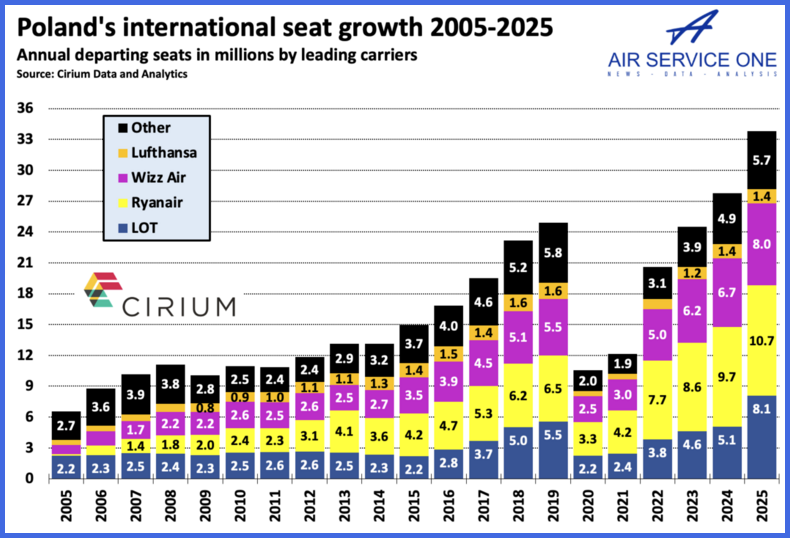
In 2026, traffic is expected to continue rising, supported by announced capacity growth, fleet expansion and new route launches. While infrastructure constraints at Warsaw Chopin Airport present short-term challenges, broader network development across regional airports is providing relief.
LOT Polish Airlines enters a new growth phase
LOT Polish Airlines remains central to Poland’s aviation ecosystem. After returning to profitability, the carrier has moved into expansion mode, reinforced by fleet growth, network diversification and a clear long-term hub strategy.
LOT carried close to 11 million passengers in 2024, with 2025 delivering further growth, including the strongest monthly passenger figures in the airline’s history. Its fleet is expanding rapidly, rising from the mid-70s to nearly 90 aircraft, with additional Boeing 787 Dreamliners and 737 MAX aircraft arriving through 2026.
A landmark order for Airbus A220 jets will also modernise LOT’s short-haul fleet and support further network growth later in the decade.
Apart from expanding operations from its Chopin hub, LOT has also grown regionally within Poland. It is increasingly deploying aircraft outside Warsaw, launching new point-to-point services from cities such as Krakow and Gdansk.
This has allowed LOT to tap into strong local demand, reduce dependence on congested Warsaw infrastructure and compete more effectively with low-cost carriers.
LOT’s expansion is closely aligned with Poland’s future aviation strategy, including the planned Central Communication Port (CPK). The airline is positioning itself to become the anchor carrier of the new hub once it opens.
Warsaw under pressure as regions drive growth
Warsaw Chopin Airport remains Poland’s primary gateway, handling a record 21.3 million passengers in 2024. However, this success has pushed the airport to the limits of its capacity.

In contrast, Poland’s regional airports are thriving. Krakow surpassed 11 million passengers in 2024, becoming the country’s second-busiest airport and one of Europe’s fastest-growing large regional airports.
Gdansk and Katowice each handled more than six million passengers, while Wrocław, Poznan and Rzeszow all posted double-digit growth.
Significant investment is underway across the regional network. New terminals, runway extensions and airfield upgrades are planned or already under construction.
LCCs are a dominant force
Low-cost carriers are the primary drivers of Poland’s aviation expansion. Ryanair and Wizz Air together account for more than half of total seat capacity, and at several regional airports their combined share exceeds 70%.
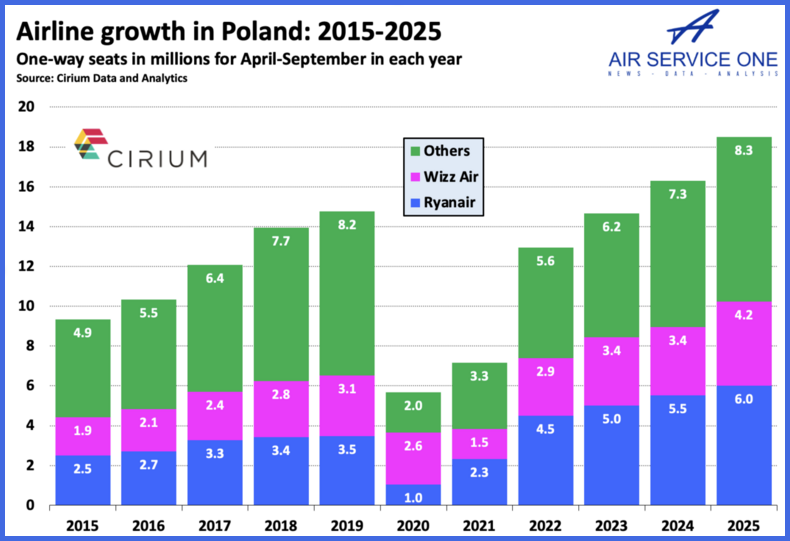
Ryanair is Poland’s largest airline by capacity, operating hundreds of routes from nearly every airport in the country. Krakow has become one of its most important Central European bases, while its continued presence at Modlin ensures dominance in the Warsaw low-cost segment.
Wizz Air, meanwhile, has deepened its Polish footprint by opening a new base at Warsaw Modlin in late 2025 and launching more than ten new routes from the airport. With over 200 routes from Poland and multiple bases across the country, Wizz Air has firmly established itself as an important player in the market.
Lublin Airport builds momentum
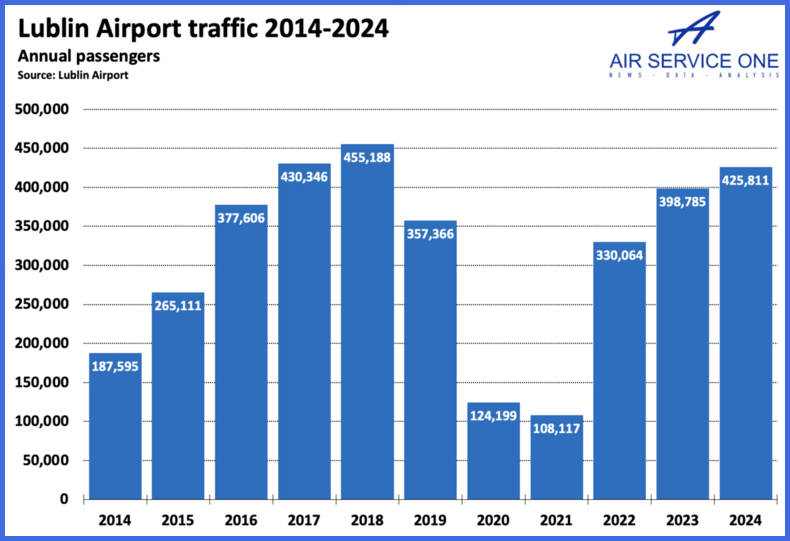
Lublin Airport remains one of Poland’s smallest commercial airports, but its trajectory is increasingly positive. Handling just over 425,000 passengers in 2024, the airport has nearly returned to pre-pandemic levels and continues to expand its route offering.
New leisure routes, including services to southern Europe and the Adriatic coast, will launch in 2026, strengthening the airport’s seasonal portfolio.