


Southern Europe drives continent’s recovery in 2025

Southern European nations will continue be a key driver of growth for the continent’s aviation sector in 2025. With a booming tourism industry, the rise of regional carriers and improving infrastructure, the region will continue to play a crucial role in driving the sector’s recovery and expansion.
Analysis of capacity data provided by airlines to Cirium shows that Europe has 359.6 million available seats in Q1, representing an increase of 6.7% on the previous year and an improvement of 2.5% on the same period during 2019.
Out of the top ten fastest-growing markets in Q1 2025 compared to six years ago, nine are in Southern Europe and the Balkans. Low-cost carriers are capitalising on this trend by expanding their presence in the region. Airlines such as Ryanair, easyJet, Wizz Air and Vueling are aggressively adding routes to connect airports in Southern Europe to major hubs across the continent. Seasonal flights and flexible fare options are catering to the influx of tourists seeking affordable travel.
Albania leads European growth
In the first quarter of 2025, Albania maintains its position with the most significant percentile increase in available seat capacity in Europe. This growth is being fuelled by its expanding tourism industry, as well as the ongoing competition between Ryanair and Wizz Air at Tirana Airport. Albania has 2.7 million seats for the first three months of the year, marking a notable 214% increase compared to 2019, equivalent to an additional 1.9 million seats.
Albania is followed by other Balkan and Southern European markets. The strong performance of national carriers, such as Air Serbia in Serbia, Aegean Airlines in Greece and a resurging ITA Airways in Italy, have also played a pivotal role in the positive trajectory of these markets, alongside the strong growth of LCCs.
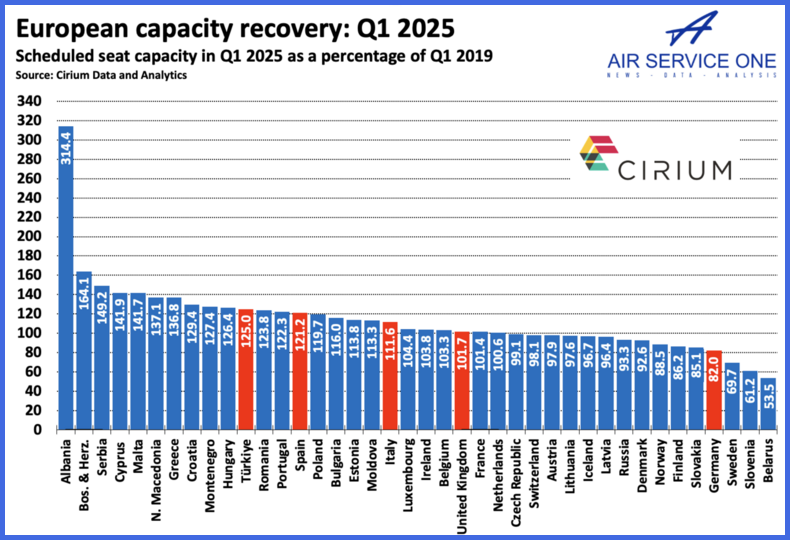

Spain and Italy are among Europe’s largest aviation markets (highlighted in red in the graph), positioning themselves as the second and fifth by available capacity on the continent. The United Kingdom leads with 71.7 million seats.
Severe supply chain issues to impact European aviation
Looking ahead, significant supply chain problems will continue to impact airline performance in Europe into 2025, raising costs and limiting growth.
Airbus and Boeing are struggling to meet delivery timelines due to ongoing supply chain disruptions. Shortages of critical components like engines and avionics, as well as recent industrial action have led to production backlogs, delaying the delivery of new aircraft. As a result of these delays, Europe’s largest airline, Ryanair, expects to carry 210 million passengers in 2025, down from the previous target of 215 million.
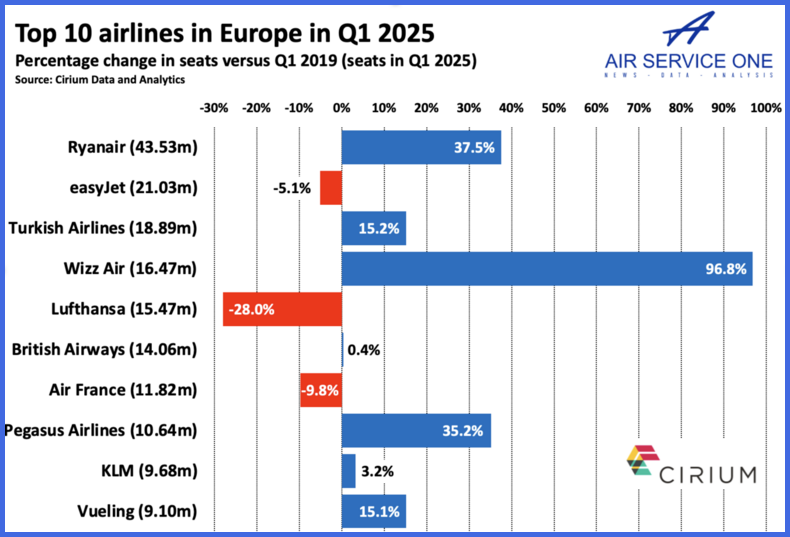
Inspections of Pratt & Whitney geared turbofan (GTF) engines, affecting the Airbus A320neo family fleet will further hinder growth perspectives for many European carriers. Wizz Air expects to have another 45 Airbus A320neo jets grounded in 2025, limiting its expansion plans. Other carriers impacted by the engine recall include Turkish Airlines, Lufthansa and Aegean Airlines, to name a few.
Despite these headwinds, Europe’s aviation sector has demonstrated resilience and adaptability in the post-pandemic era. The continent is expected to deliver another year of modest growth in comparison to 2019.