

Spain leads Europe with strong growth and connectivity

The Spanish aviation market is one of the largest in Europe, driven by a combination of strong domestic demand and international tourism. It ranks as the second largest market by available seat capacity on the continent during Q1 2025, behind only the United Kingdom.
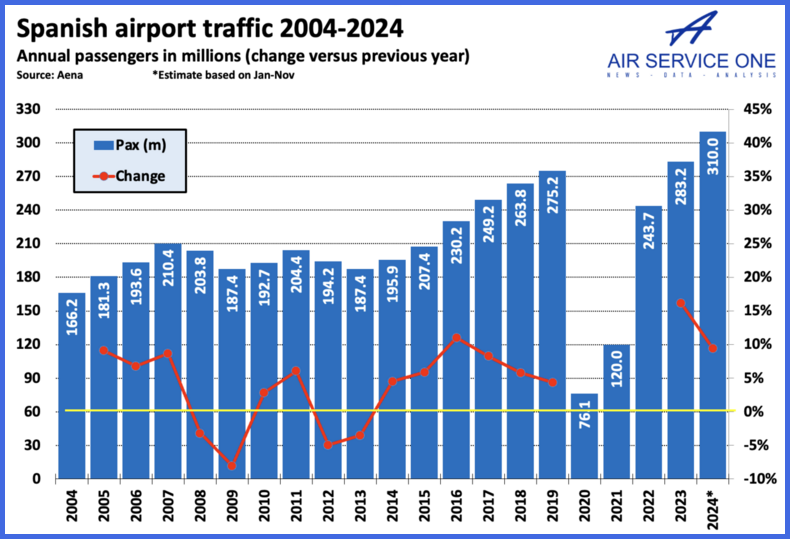
Passenger volumes in Spain have consistently risen since 2004. The Covid-19 pandemic caused a sharp 50% drop in seat capacity, plummeting from 52 million in 2019 to just 26.7 million in 2020. However, a strong rebound began in 2021, driven by leisure travel. In 2024 capacity rose 12.4% over pre-pandemic levels.
Despite being one of the hardest hit by the pandemic, Spain was able to reopen relatively quickly and benefit from the pent-up travel demand across Europe.
The growth trajectory is expected to continue, with forecasts estimating an annual passenger growth rate of 3.5% up to 2028. The sector benefits from Spain’s geographical location, serving as a gateway between Europe, Africa, and Latin America.
Madrid and Barcelona among Europe’s busiest airports
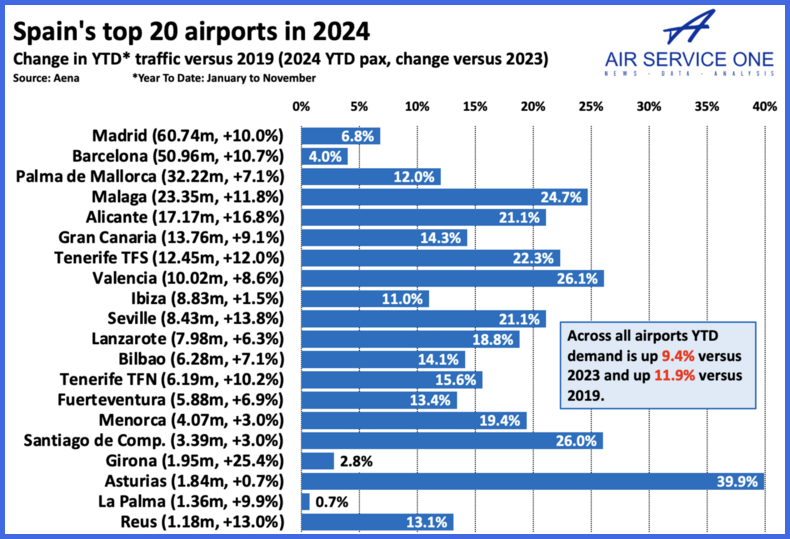
Madrid and Barcelona rank within the top ten busiest airports in Europe by both the number of passengers carried and available seat capacity. Regional airports, such as Malaga and Palma de Mallorca, also play vital roles in supporting Spain’s tourism economy.
Spain has successfully leveraged ongoing geopolitical uncertainties in other regions to boost air traffic during the winter months, despite the pronounced seasonality of some regional airports that primarily cater for summer tourism.
Airlines in Spain are projected to register a 12% increase in sales this winter than a year earlier as travellers look to steer well clear of conflict zones. Tourist destinations such as the Canary Islands are recording more flights as some airlines re-route planes from Israel and other points in the Middle East,
Ryanair is Spain’s largest airline
Spain’s aviation market is highly competitive, dominated by both legacy carriers and low-cost airlines. Iberia, the national flag carrier and part of the International Airlines Group (IAG), leads the full-service segment. Vueling, also under IAG, operates as one of Europe’s leading low-cost airlines.

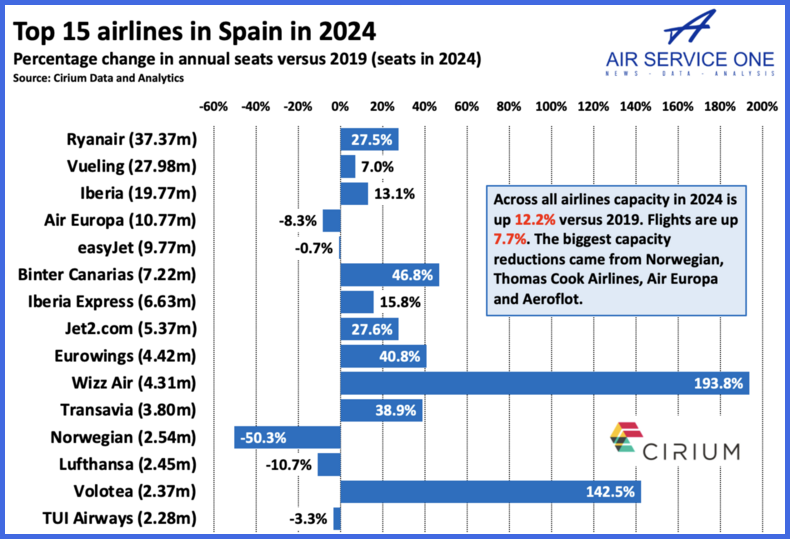
Ryanair holds the largest market share in Spain, accounting for 21.9% of passenger numbers and capacity. As Europe’s leading low-cost carrier, Ryanair has established a strong presence in the country by offering an extensive domestic and international network.
The airline aims to grow passenger traffic to Spain to 77 million people from 55 million forecast for 2024. It added 63 new routes to its schedule in Spain last summer, bringing the total number of connections in the country to 765. The company maintains operations at 27 airports in Spain, of which a dozen are operating bases with 103 stationed aircraft.
Meanwhile, Air Europa focuses on long-haul flights, particularly to Latin America. However, its proposed merger with Iberia, which aimed to consolidate and strengthen the Spanish aviation sector, was ultimately abandoned due to regulatory hurdles and competition concerns. Despite this setback, Air Europa continues to pursue growth opportunities.
The UK is Spain’s leading international market
Growth in Spain is being driven by increasing international arrivals, particularly from the EU, UK, and the Americas, coupled with rising domestic travel.
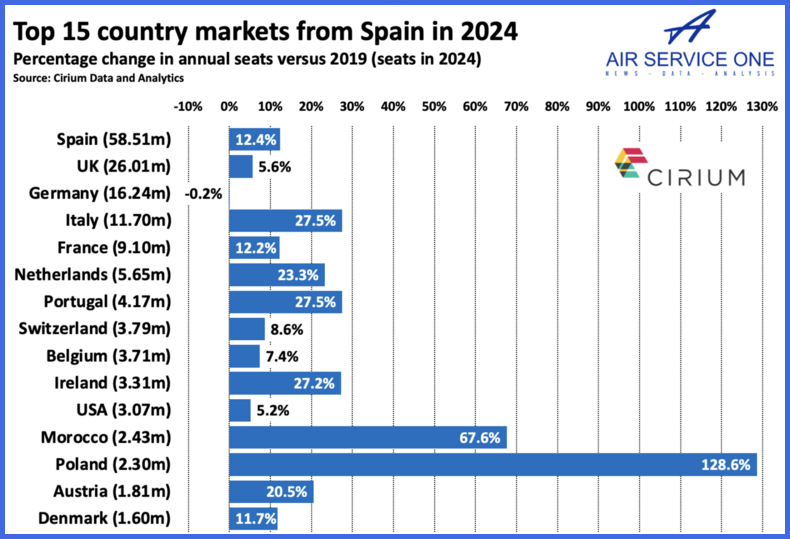
Spain’s domestic market continues to dominate, leading with 58.5 million seats in 2024. This represents a strong 12.4% increase compared to pre-pandemic levels in 2019.
The United Kingdom remains Spain’s largest market, with 24.6 million seats in 2019, growing to 26 million in 2024, representing an increase of 5.6%. Tourism and business links continue to drive demand between the two nations.
On the other hand, Germany’s recovery has been slower, with seat capacity just shy of pre-pandemic levels at 16.2 million in 2024, a marginal decline of 0.2%. This slower rebound is linked to Germany’s recovery which has lagged other markets on the continent.
