

Strasbourg welcomes back easyJet but loses Turkish Airlines and Air France; Volotea now dominant carrier

Strasbourg is the official seat of the European Parliament and is home to what was, for 227 years (1647-1874), the world’s tallest building (the stunning 15th century cathedral). Close to the German border (you can take a tram across the Rhine to Kehl in Germany) its airport is a short €5, 10-minute train ride from the impressive main station in Strasbourg.
TGV link to Paris wiped out 50% of traffic
In the early 2000s Strasbourg welcomed up to two million annual passengers. In 2006 almost half the airport’s annual seat capacity was dedicated to serving Paris’s two main airports, Orly and CDG. When the first phase of the LGV Est line was completed in 2007, journey times by train between Paris and Strasbourg fell from four hours to just two hours 20 minutes. The completion of the second phase in 2016 further reduced the train journey time to one hour 45 minutes. Analysis of Cirium schedules data shows that annual one-way seats to Paris fell from almost 800,000 in 2006 to under 300,000 by 2010. Capacity fell significantly again in 2013 and regular scheduled flights were terminated completely in 2016.
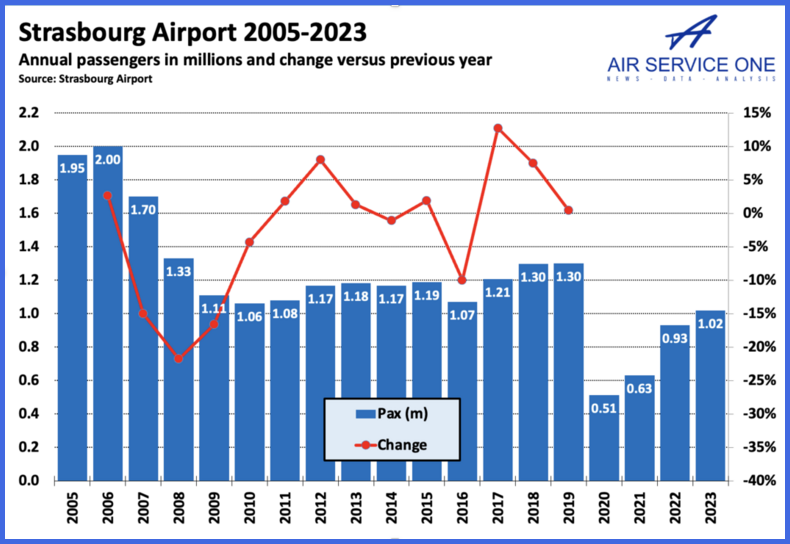
Passenger numbers gradually recovered from just over one million annual passengers to 1.3 million in 2018 and 2019. Traffic this year is set to be around 1.25 million, significantly up on 2023 when the airport was closed for a month from mid-March to mid-April for runway work.
December is a busy month
In each of the last two years, 2022 and 2023, December has been the busiest month of the year for traffic. However, back in 2019, June and July were the busiest months, with December ranking third. Where December will rank in 2024 remains to be seen, but based on known capacity data it appears December will again be Strasbourg’s busiest month.

Volotea replaces Air France as leading carrier; easyJet returns
Air France and its regional subsidiary HOP! used to be the dominant airline in Strasbourg but its market share has fallen rapidly as Volotea has increased its presence at the airport. Air France’s only remaining route is to Lyon, which operates up to 3-daily, Monday through Friday, using Embraer E170s. The airline’s 370-kilometre service is set to terminate at the end of March and will be taken over by TwinJet, the French regional carrier which already serves Marseille.

Meanwhile, Volotea offers over 20 routes across the year, though around half only operate during either the summer or the winter. It operates domestic routes year-round to Bordeaux, Marseille, Nantes, Nice and Toulouse, as well as seasonal flights to Ajaccio, Bastia, Biarritz, Calvi, Figari, Montpellier and Tarbes/Lourdes. A new year-round service to Brest was launched on 7 November.


The biggest news this winter has been the return of easyJet which is now offering service to Strasbourg from four of its bases; Barcelona, London Gatwick, Naples and Nice. The carrier last served Strasbourg in March 2016 from just London Gatwick. Next summer will see the addition of a fifth route to Palma de Mallorca.
Several other carriers are present at the airport:
- Air Arabia Maroc to Fez and Nador;
- Amelia Airlines to Amsterdam (service suspended from 25 October 2024);
- ASL Airline France to Oujda;
- Iberia to Madrid;
- Nouvelair Tunesie to Djerba and Tunis;
- Royal Air Maroc to Casablanca;
- Ryanair to Agadir and Porto;
- Tassili Airlines to Algiers, Constantine and Oran;
- Transavia to Algiers and Cozumel;
- Tunis Air to Tunis.
Turkish Airlines has recently suspended operations from Istanbul (last flight was on 7 September according to flightradar24.com) and will be replaced on the route next summer by Transavia.
Nice is top domestic route, Tunis top international route
Analysis of Cirium schedule data reveals that six of the airport’s top seven routes this year are domestic routes with Nice leading the way (served now by both easyJet and Volotea), followed by Bordeaux and Toulouse. The top two international routes are both in North Africa (Tunis and Algiers).
While five of the top six longest routes this winter are to airports in Morocco, the airport’s longest route is the weekly (Saturday) Volotea service to Lanzarote in the Canary Islands, a sector length of 2,832 kilometres
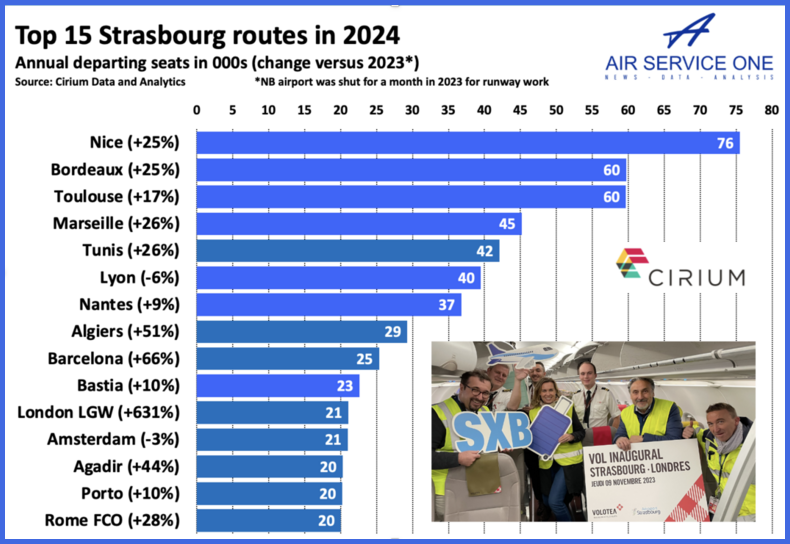
Traffic is split roughly 60:20:20 between domestic routes, EU routes and other international routes according to the airport’s own monthly statistical report. The new routes being offered by easyJet should push up the EU share in 2025.
