Thailand’s aviation sector rebounds as airport limits steer expansion
The Thai aviation sector continues to recover from the lingering effects of the coronavirus pandemic, with 2025 bringing an additional 4.9 million passengers across the country’s airports compared to the previous year, alongside an improvement in passengers per flight.
In total, Thailand’s airports handled 145.1 million travellers in 2025, up from 140.6 million a year earlier, although still below the pre-pandemic peak of 161.8 million.
With major infrastructure developments underway in Bangkok and ongoing expansion across key leisure gateways, the country is well positioned to further strengthen its status as one of Asia’s most dynamic aviation markets.
Thailand continues to be anchored around two core demand pillars: dense domestic routes centred on Bangkok and strong international leisure and visiting friends and relatives (VFR) traffic. The largest domestic sectors, particularly Bangkok – Phuket and Bangkok – Chiang Mai, remain among the busiest in the country, feeding both tourism and internal connectivity.
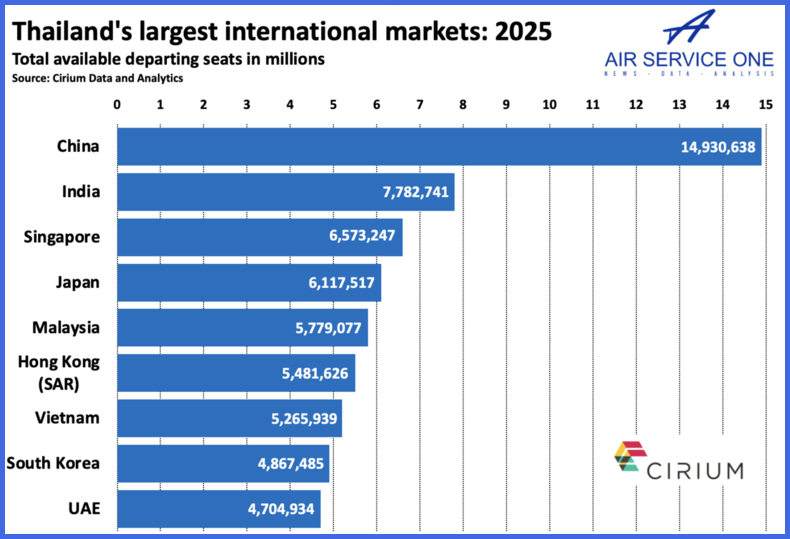
Internationally, the market has been reshaped by shifting demand flows. While China remains below full recovery, airlines have actively pursued alternative growth opportunities.
India and Russia have emerged as key contributors, while new or expanding links to Central Asia and Oceania have provided additional diversification.
At the same time, airport constraints are increasingly shaping network development.
Several key airports are operating at or above their designed capacity, meaning growth is being channelled into larger aircraft, improved scheduling and operational efficiencies rather than new slots or frequencies.
Seasonality remains strong, with peak winter demand placing additional pressure on already constrained infrastructure.
Bangkok’s twin airports drive growth
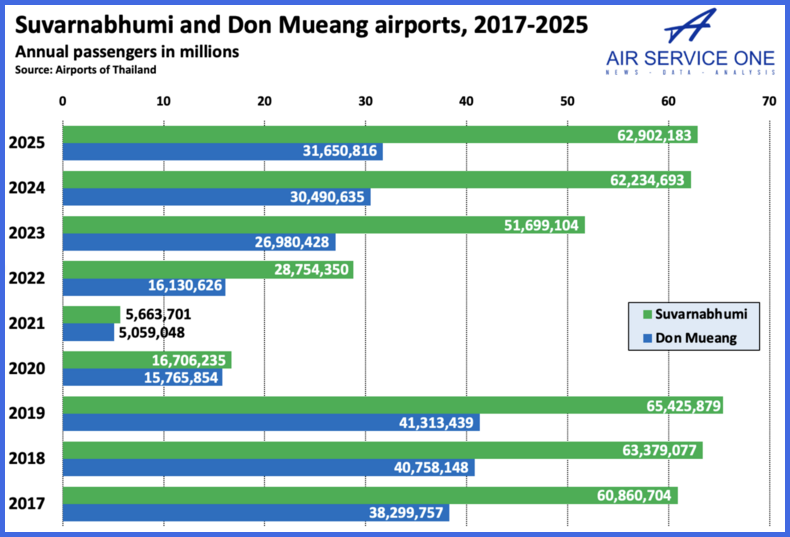
Bangkok’s dual-airport system, comprised of Suvarnabhumi International and Don Mueang International, remains the centre of gravity for Thailand’s aviation market and the focal point of both its ambitions and its challenges.
The opening of the third runway at Suvarnabhumi in late 2024 was a critical milestone, enabling an increase in hourly movements and supporting higher overall capacity.
In 2025, the focus shifted from infrastructure delivery to operational optimisation, with authorities working to improve throughput, passenger processing times and overall efficiency.

The expansion pipeline remains extensive. Plans include the Suvarnabhumi East Expansion project, which aims to lift capacity to around 80 million passengers annually by 2030, alongside longer-term developments such as a new South Terminal and a fourth runway.
Don Mueang, Bangkok’s secondary airport, is also set for significant investment. Terminal 3, designed to handle up to 50 million passengers per year once complete, is expected to open in the 2030s, reinforcing the airport’s role as a low-cost carrier hub and providing much-needed capacity relief for the capital’s aviation system.
Beyond Bangkok, Thailand’s secondary airports play an important role in supporting the country’s tourism-driven aviation model. Phuket and Chiang Mai stand out as major gateways, handling 17.4 million and 9.5 million passengers respectively in 2025.
Smaller but fast-growing airports such as Samui and Krabi are demonstrating the diversification of Thailand’s tourism geography. Both have exceeded pre-pandemic passenger levels, showing a shift toward more distributed travel patterns and reducing reliance on Bangkok-centric flows.
LCCs dominate Thai market
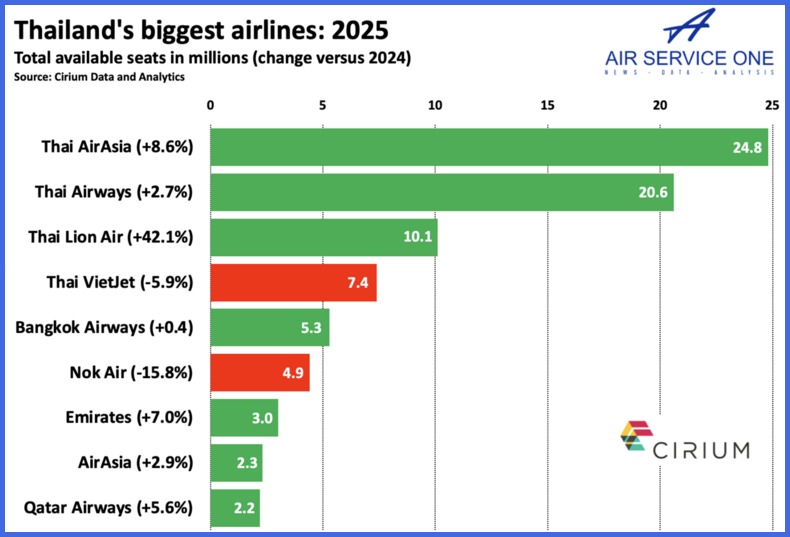
Thailand’s airline market is clearly divided between low-cost carriers and legacy operators, particularly on the domestic front where LCCs dominate capacity and passenger volumes.
The market is led by Thai AirAsia, which has firmly established itself as the country’s largest airline through a capacity-driven strategy focused on high utilisation and dense domestic networks.
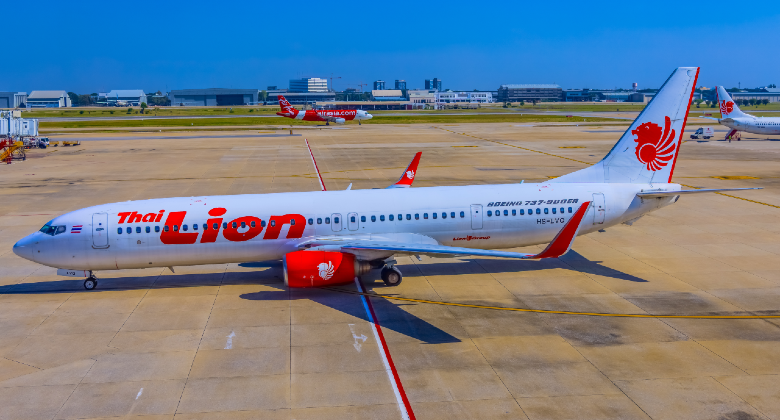
Other budget carriers, including Thai Lion Air and Thai VietJet, further reinforce the segment’s dominance, while full-service airlines such as Thai Airways and Bangkok Airways play more targeted roles.
Bangkok Airways has carved out a niche as a premium regional connector with a strong domestic focus and extensive partnership network, while legacy operators maintain relevance through long-haul connectivity and network depth rather than scale in the domestic market.
On international routes, however, the structure shifts considerably, with foreign airlines accounting for most of the traffic and shaping overall market dynamics.
While Thai carriers retain a presence, particularly through Thai Airways and the AirAsia Group’s long-haul operations, international capacity is largely driven by overseas network carriers and regional low-cost operators.