

Tokyo NRT remains Japan’s #1 international airport; Jetstar Japan the top carrier

Tokyo NRT plays a critical role in travel to, from and within Japan. According to Cirium schedule data, it has 11.9 million two-way seats in Q2 2026 (April-June), making it the country’s second-busiest airport, after Tokyo HND.
It is NRT’s third-best Q2 on record. Total capacity has risen by 1% year-over-year, but it is still smaller than it was before the pandemic in Q2 2018 and 2019. The lack of recovery is, in part, due to HND growing internationally and several airlines pulling out of NRT recently.
Despite the changes, NRT remains Japan’s top international airport. In the three months examined, some 9.9 million two-way seats are not within Japan (83%), which is only its tenth-best quarter to date. The arrival of Iberia and Thai AirAsia in 2024 and Air Cambodia, Parata Air and Thai VietJet Air in 2025 have helped its figures.
Neither ANA nor JAL is NRT’s top airline
Cirium shows that 80+ passenger carriers serve NRT. As ANA and JAL are focused on HND, where most of their domestic operations are from, they do not dominate at Tokyo’s second-busiest airport. The LCC Jetstar Japan does, although it is half owned by JAL. The unit has 1.3 million two-way seats, which is 11% of the airport’s capacity.
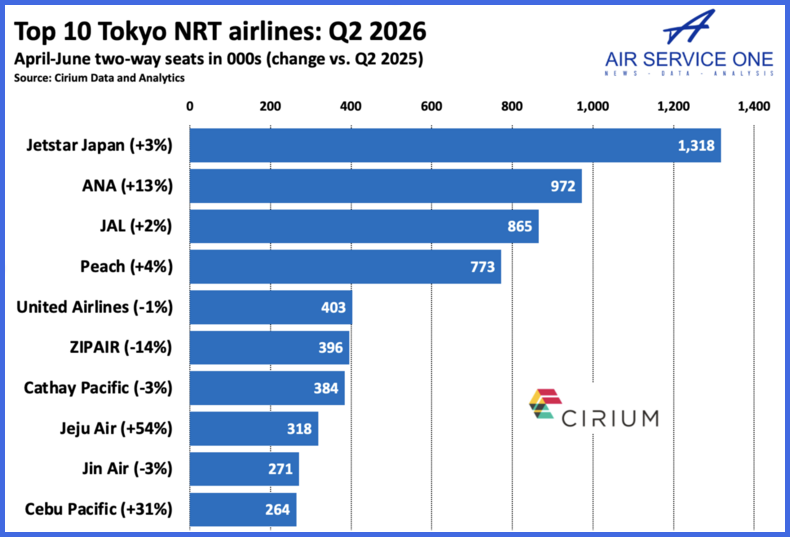
Jetstar Japan has 18 routes from NRT in Q2. Some 13 routes are domestic, accounting for 86% of its capacity. It is the largest domestic operator from the airport, followed by Peach, ANA and JAL. Jetstar Japan’s international offering comprises Hong Kong, Kaohsiung, Manila, Shanghai PVG and Taipei.

Approximately 30% of NRT’s passenger capacity is long-haul, which is provided by 35+ airlines. Despite ANA and JAL’s smaller role overall, they are the top two long-haul operators. Nonetheless, 62% of the seats are provided by foreign carriers.
It has passenger flights to 100+ destinations
According to Cirium data, NRT has nonstop flights to 102 destinations in Q2, of which 17 are domestic and 85 are international. Compared to the same period in 2025, Delhi, Koror and Taichung are served again. In contrast, 11 airports, including nine in China plus Dhaka and Kota Kinabalu, are no longer part of its network, although several will return later this year.
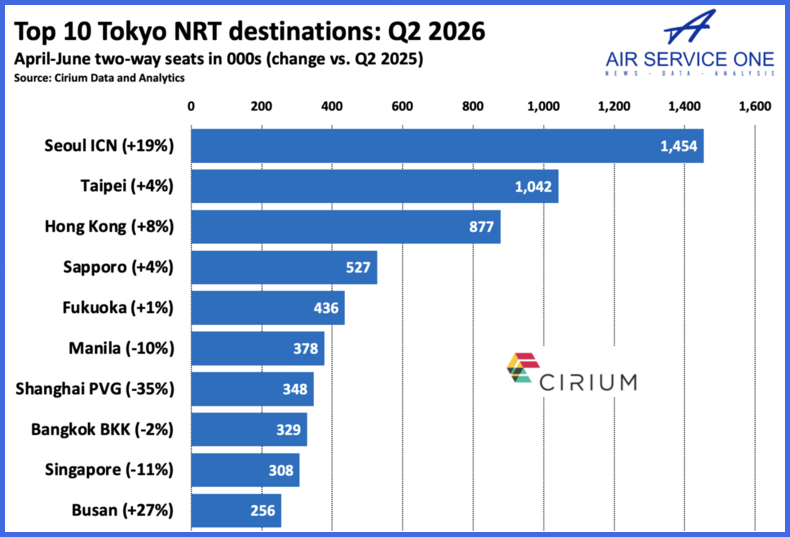
Its international destinations are in 38 countries and territories. With 1.9 million two-way seats, South Korea remains the most-served nation. Flights have been gained to Palau, but Bangladesh is no longer served.
With 1.5 million two-way seats, Seoul ICN is the most-served market from NRT. Some 241-weekly departing flights will be available in May, provided by Jeju Air (48), Eastar Jet (28), Korean Air (28), Jin Air (25), Air Seoul (21), Asiana (21), T’way Air (21), Air Busan (14), Parata Air (14), Air Premia (10), ZIPAIR (7) and Ethiopian (4).
