


US leads North America travel amid capacity constraints

The main markets in North America – the United States, Mexico, and Canada – will achieve another record-breaking start to the Northern Hemisphere’s winter season in the fourth quarter. However, capacity remains limited, and growth is progressing slowly due to persistent supply chain challenges.
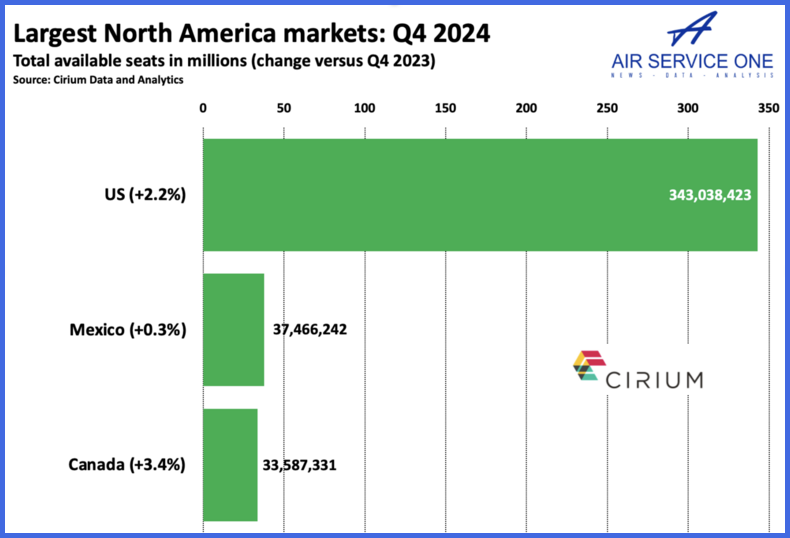
An analysis of data provided to Cirium reveals that the North American market has a record 390,359,851 seats available in Q4, marking a 2% increase over the same period last year and a 5.6% improvement on the pre-pandemic 2019. The US, driven by the busy Thanksgiving travel season, dominates the continent’s capacity with 343 million seats, followed by Mexico with 37.5 million seats and Canada with 33.6 million.
Compared to the same winter quarter in 2023, the US market will grow by 2.2%, while Mexico’s growth will slow to just 0.3%. Canada, despite the collapse Lynx Air and Canada Jetlines, is expected to see a 3.4% increase in capacity.
US capacity to Mexico overtakes Canada
Post-pandemic, the US – Mexico air travel market has now clearly overtaken the US – Canada market based on annual seat capacity. This has been helped by the US Federal Aviation Administration (FAA) restoring Category 1 status to Mexico in September 2023. The FAA had downgraded Mexico to Category 2 in May 2021. The return to Category 1 has enabled Mexican airlines to once again launch new routes to the US.
During the fourth quarter, available seat capacity between the US and Mexico is up 40.4%, with 12.6 million seats between the two. In comparison, there are just 9.6 million seats between the US and Canada over the same period, down 4% on five years ago.

Canada yet to reach pre-pandemic figures
Canada’s aviation sector is yet to return to pre-pandemic capacity levels during the ongoing Q4 2024. With 33.6 million seats on the market, the country has seen a 3.8% increase compared to last year, but this figure remains 2.2% below the capacity recorded in the same period in 2019.
The recent loss of two Canadian carriers, Lynx Air and Canada Jetlines, which together accounted for over 500,000 seats in Q4 2023, has not significantly impacted Canada’s year-on-year growth rate. This gap has largely been filled by foreign carriers, which have expanded their operations to Canada in response to the recovering demand for travel following the stringent pandemic restrictions of the past few years.
US carriers lead North American market
Out of the ten largest airlines on the continent based on available capacity in Q4, eight are from the US. The three largest legacy carriers – American, Delta, and United – commonly referred to as the US Big Three hold 47.4% of North America’s total capacity in Q4. All three boast a record number of seats on the market, outstripping their pre-pandemic performance.
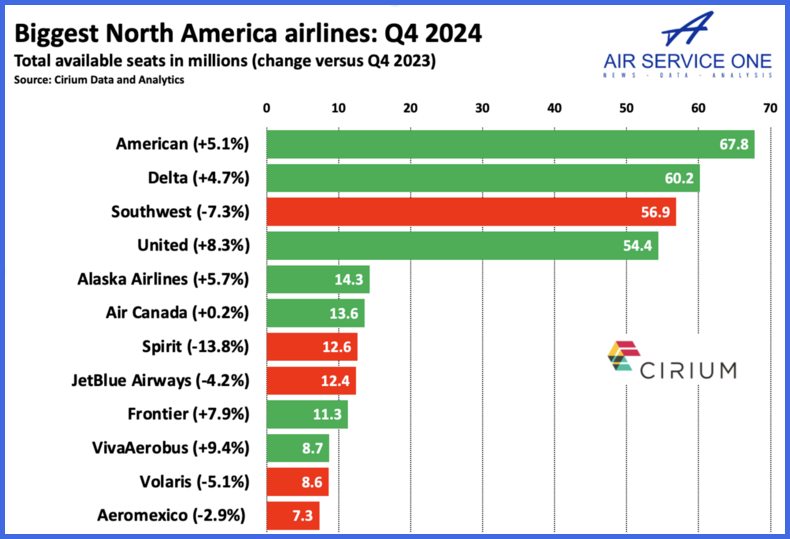
On the other hand, airlines in the US have been unable to escape ongoing issues by suppliers, including aircraft manufacturers. Southwest Airlines is cutting capacity and reevaluating its full-year financial outlook because of fewer expected aircraft deliveries from Boeing.
ULCC Spirit Airlines has shelved 35 routes this quarter, slashing over two million seats compared to its original plan amid mounting debt and a weak financial performance. Issues with RTX’s Pratt & Whitney geared turbofan engines have also forced the airline to ground multiple planes and left it with bloated costs.
