Washington DC’s winning partnership: MWAA and Destination DC drive aviation growth

Washington, DC is a city that thrives on connectivity – political, cultural, and increasingly, air connectivity. At the heart of this growth stands a powerful partnership between the Metropolitan Washington Airports Authority (MWAA) and Destination DC, the capital’s official tourism marketing organization. Together, they are not only building new routes but also positioning Washington as one of the most compelling destinations in the United States for airlines, visitors and global events.
Chryssa Westerlund, Executive Vice President & Chief Revenue Officer at MWAA, and Elliott L. Ferguson, II, President & CEO of Destination DC, spoke to Air Service One about how their close partnership is helping to drive new air services, promote Washington, DC internationally and enhance the city’s competitiveness as both a tourism and business destination.
Washington Dulles International Airport is the U.S.’s fastest-growing international hub
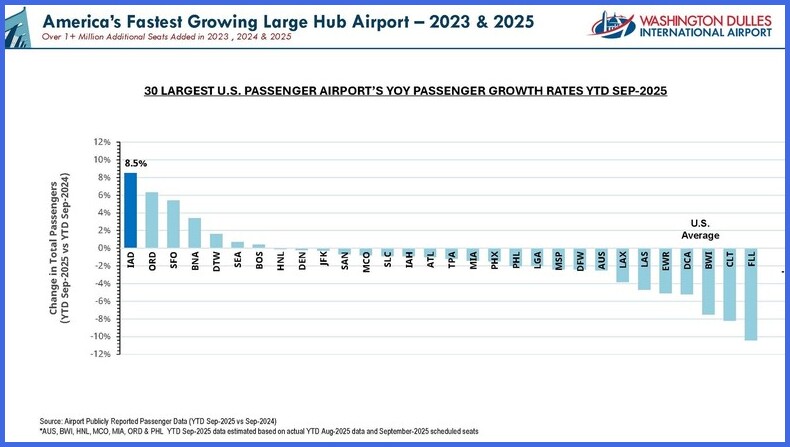
Westerlund highlighted how far Washington Dulles has come since the pandemic. “Washington Dulles has already surpassed all of its pre-pandemic levels for every region except Asia,” she said, adding that the airport “has recently been named the fastest growing international hub airport in the United States in both 2023 and 2025,” a recognition that reflects its expanding global reach.
One of the standout achievements has been in Africa, where Washington Dulles has overtaken larger competitors. “We’re now the number one airport across all of the Americas for most destinations served in Africa, surpassing John F. Kennedy International Airport in New York earlier in 2025,” Westerlund explained. “We continue to see tremendous momentum globally for air service to Washington DC.”
Asia now represents the largest market of opportunity for Washington DC, with more than 80% of unserved market potential located in the region. While the geographic distance between Asia and Washington, DC presents logistical considerations, it also highlights the importance of expanding air service connections.
With airspace restrictions complicating ultra-long-haul routes, the challenge is capacity rather than demand. As Westerlund put it, “the business case is there if the airlines can get the aircraft.”
The destination advantage
For Ferguson, airport growth is inseparable from the city’s broader appeal. “Strong infrastructure is essential to an exceptional visitor experience,” he said. “Expanding non-stop service in key markets, enhancing airport efficiency, and ensuring seamless connections are all critical to strengthening Washington, DC’s global accessibility.” A major selling point for international travelers is the recently completed Silver Line extension of the Metro, which links Washington Dulles directly to downtown for less than seven dollars.
Ferguson emphasized that this ease of access is paired with exceptional value once travelers arrive. “Visitors are always surprised when we tell them there are more than 100 free things to see and do in the city, including 16 Smithsonian museums and the National Zoo. That allows visitors to invest more in exceptional hotels, world-class dining and unforgettable experiences — all of which fuel the city’s visitor economy.”
The coming years offer unique opportunities to showcase Washington on the world stage. As the nation prepares to celebrate America’s 250th anniversary in 2026 and host major global sporting events, the capital stands out as a vibrant, walkable and welcoming city that reflects the best of the United States.
Ferguson described the city’s appeal simply: “The value of Washington is in its accessibility, safety and authenticity. When visitors arrive, they see a city that is green, clean and open. That experience, combined with strong air service, is what keeps visitors coming back.”
A “secret sauce” partnership
According to Westerlund, what sets Washington DC apart in a competitive air service market is its strong local alignment. “The secret sauce we have is the tremendous partnership with Destination DC and our economic development partners,” she said. “When it comes to air service, our elected officials, our tourism leaders and our airports are all in lockstep. When Elliott stands beside us in meetings with airlines, his global reputation adds enormous credibility. He is one of our best salespeople.”
Ferguson echoed the sentiment, stressing that the collaboration is not just symbolic. “When MWAA goes after a new route, we actively promote Washington, DC in that airline’s home market,” he explained. “It’s not just about filling planes coming in, it’s making sure they are full on the way back as well.”
With offices in seven international markets including China, India, the UK and Brazil, Destination DC plays a critical role in ensuring route success from both ends. Both organizations are united in prioritizing markets that deliver longer stays and higher visitor spending.
Before the pandemic, China was Washington’s largest overseas source market, though recovery has been slower in recent years. India, by contrast, has surged. “International visitors only make up 8% of arrivals but represent 27% of visitor spending,” Ferguson noted. “Our goal isn’t to attract 40 million tourists. The city is not built for that. Instead, we want sustainable growth through high-value international markets.”
International airlines continue to play an outsized role at Washington Dulles. Of the 48 airline partners at IAD, 36 are foreign flag, marking Washington Dulles one of the most diverse international gateway hubs in the United States.
He pointed out that Brazil, Mexico and South America are currently strong performers, while Asia remains a long-term priority. At the same time, Washington’s growing reputation as a meetings and conventions hub adds further strength, with more than 4,000 associations headquartered in the region.
Infrastructure investments for the future
MWAA is also ensuring that its airports are ready for the next wave of growth. Under a new 15-year lease agreement, $9 billion in infrastructure projects are planned.
The centerpiece is a new concourse at Washington Dulles, scheduled to open in September 2026, followed by additional phased construction. Reagan National Airport is also anticipated to replace its oldest facility, Terminal 1.
Westerlund highlighted that these upgrades are being built without disrupting current operations: “We can construct these concourses without displacing air traffic, which is a huge advantage. Our passengers and airlines will see a seamless transition into a new era of growth.”