

DFW targets renewed growth as major expansion gathers pace
Dallas Fort Worth International Airport (DFW) is looking to accelerate passenger growth in 2027, supported by a $12 billion infrastructure investment programme and further international network development.
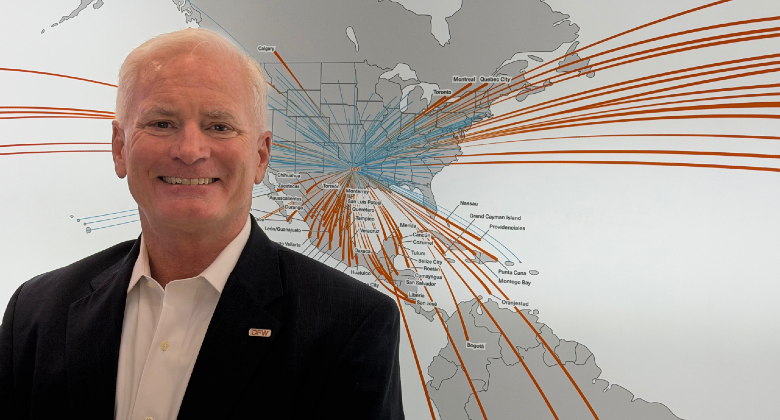
Speaking to Air Service One at World Routes in Frankfurt, the airport’s CEO, Christopher McLaughlin, outlined plans to expand capacity, strengthen connectivity to Asia and South America, and position DFW to handle 100 million passengers annually by 2030.
DFW continues to strengthen its international network, supported by new airline entrants and expansion by its largest carrier, American Airlines. Recent additions have included Royal Jordanian and EVA Air, while American Airlines has introduced services to several key overseas markets. International passenger traffic has increased by 2.5% year on year in 2026, demonstrating the resilience of demand for overseas travel.
DFW sees opportunities for further long-haul development in the future, particularly in regions where connectivity has yet to recover to pre-pandemic levels.
“Two areas where I would say we continue to be soft relative to where we were before COVID: Asia is a market that we think there’s still tremendous opportunity to serve. And then we think there’s more opportunity in South America”, McLaughlin explained.
The airport expects growth in both regions over the coming years as additional international gates become available.
Domestic connectivity also remains central to DFW’s strategy. The airport currently serves 194 destinations across the United States, providing extensive feed for international services. McLaughlin believes there is scope to increase frequencies to existing destinations, particularly smaller and medium-sized markets, as American Airlines continues expanding its largest hub.
“American proudly refers to us as their fortress hub and has aspirations to grow even further at DFW”, he said, noting that expansion would encompass both additional international services and greater frequencies across the domestic network.
DFW is also promoting the strength of its local market to prospective airline partners. McLaughlin highlighted the Dallas–Fort Worth metropolitan area’s rapid population growth, expanding corporate presence and economic diversification as important factors supporting future demand.
“Our connectivity is better than anyone”, he said, pointing to the airport’s extensive domestic network, with almost all mainland US destinations accessible within four hours. For airlines targeting local and visiting-friends-and-relatives traffic, the region’s economic and demographic growth provides another compelling proposition.
Investing in the next phase of growth through DFW Forward
DFW Forward, a $12 billion capital programme designed to increase airport capacity by approximately 20% is at the centre of the airport’s development strategy. Its centrepiece is the construction of Terminal F, which will ultimately feature 31 gates, including eight capable of handling wide-body international aircraft.
The first phase of Terminal F includes 15 total gates. Next summer, a majority of the phase one gates will come online, with the remainder opening by the end of 2027. The full terminal is expected to be completed in 2030.
Meanwhile, Terminal C, the airport’s oldest terminal dating back to 1974, is undergoing a comprehensive reconstruction while remaining operational. The project will ultimately deliver 32 gates, with completion scheduled for 2029. DFW has also added ten additional gates at Terminal A, while Terminal D is benefiting from an expanded premium lounge offering.
“We’re in the middle of a major capital program, spending about $12 billion to add about 20% capacity to our airport. We’re obviously already a quite large airport, so adding 20% is significant”, McLaughlin said.
The investment extends beyond terminal infrastructure to include roadway improvements, runway rehabilitation and additional end-around taxiways designed to improve operational efficiency. The airport expects to complete rehabilitation of its fourth main north–south runway in spring 2027.
McLaughlin expects the additional capacity to support renewed passenger growth as new gates progressively enter service, bringing the airport closer to its long-term traffic ambitions.
“All the pieces have to work together for us to launch what we think will be 100 million passengers by the year 2030”, he concluded.
